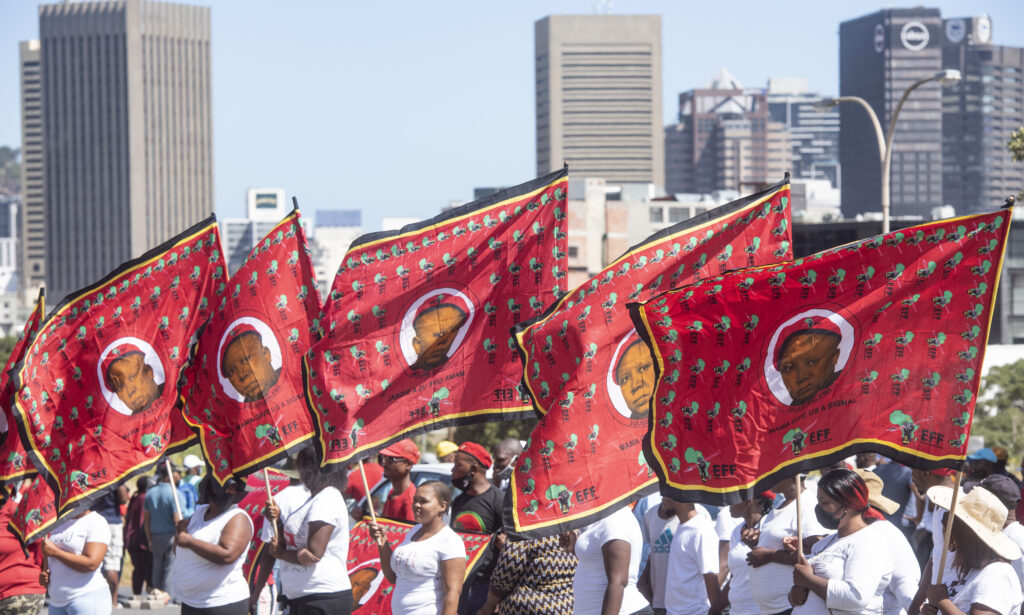
It’s not funny. It’s actually pretty scary. But all the white racists who voted “no” in the 1992 referendum, which asked white voters whether they’d be OK with “power sharing” with the ANC, are vindicated. Turns out there’s not enough power to share.
All the doomsayers who predicted infrastructure decay and economic collapse, all those who fled South Africa to make a home in Australia or elsewhere, now appear to have been right. They may have been right for the wrong reasons, and may have expressed it in distasteful terms, but right they were.
“There is no power crisis,” said President Thabo Mbeki in May 2006. Yeah right, dear leader. Amandla aWethu (“Power to the people!”), right? Sorry, Mr President, but a belated apology 18 months later doesn’t keep the lights on. (It’s worth noting that, judging by the Google results, this is just about the only significant apology Mbeki has ever offered for anything.)
Eskom, which is going to bear the brunt of the public’s dissatisfaction with the regular — often daily — power outages that will be our lot for at least the next five years, is telling the government not to advertise South Africa as a destination for foreign investment:
Bongani Nqwababa, Eskom’s finance director, said yesterday that the parastatal had advised the government that it wanted South Africa marketed only from 2013 for both local and foreign projects. It was inappropriate to advertise South Africa as an investment destination with low-cost electricity. “You don’t sell what you don’t have.”
He warned that the Rio Tinto Alcan aluminium smelter in the Coega industrial development zone could be delayed. “Eskom needs to review supply to Coega.” Other projects, such as BHP Billiton’s plans to expand, were on the back burner.
When Eskom and Alcan had signed a 25-year power-supply agreement in November 2006, both made commitments that, if reneged on, would incur penalties. Nqwababa said: “There must be penalties [but] I am sure they are cheaper than building a power station.”
Pranill Ramchander, an Anglo American spokesperson, said Eskom’s comments about stalling new developments were still under discussion. There was no agreement. Obviously, if it became government policy, it would affect projects Anglo had planned.
One wonders if Fifa has been informed. After all, it wants to run a Football World Cup here in 2010. Maybe they can play the matches in daylight and use old-fashioned tear-off tickets.
Eskom is still talking up the supposed “independent power producers”, those endangered private-sector creatures that were supposed to start building or buying power stations nearly a decade ago, but declined the government’s proposal that they invest billions in power stations whose output would be priced by the buyer, rather than the seller.
The same happened with the disaster that is telecommunications. Having turned the state incumbent into a semi-private monopoly that raped South Africa for almost a decade, the government puzzled over why South Africa’s fixed-line density was declining and telecoms prices were rising, when exactly the opposite was happening everywhere else in the world. So they cobbled together a duopolist, Neotel, and planned a government-run cable that would sell cheap bandwidth to this new competitor only. This idiocy is officially going ahead.
Yet these moves go to the root of the problem. The doomsayers weren’t right because blacks can’t run a country. Alec Erwin, the Minister of Public Enterprises (who famously said “sabotage is everywhere” before saying “human instrumentality” would be a better term) is white as the driven snow. The doomsayers were right because a motley collection of communists, unionists, socialists and Keynesian statists can’t run a country.
I noted the genesis of the power problems in a post last year. It’s time the government turns away from the notion that key “enterprises” should be run by the state “for the benefit of the people”. The people, whether poor or rich, are not benefiting.
I can’t remember a time when more people were adamant they’re leaving. The debate isn’t about whether, but when. Here’s Wayne, one of the politics students who blog over at Commentary.co.za, making his case for leaving. I can hear the trite responses now: “Let them leave!”, “Traitors!”, “Racists!”, “Good riddance!”. But when everyone who can afford to leave has left, what will happen to South Africa? Where will the economic growth, the jobs, the prosperity come from? These are exactly the sort of people this country can ill afford to lose.
The repercussions of these power cuts will be dramatic. We can forget about achieving those much-vaunted growth targets. We’ll be lucky to stay in positive territory, let alone achieve the double-digit growth that we really need to deal with 25% unemployment and high levels of poverty. And lo and behold, writes one local paper: “SA’s 2014 poverty plan in the dark”:
Fanie Joubert, an economist at Efficient Group, said a three-hour power outage cost the economy about R2-billion in lost production each day, or 22% of daily output. “If sustained, the shortages may cut nominal GDP [gross domestic product] growth by 2,2 percentage points a year,” he said.
Expect inflation too. Lots of it. All these costs will eventually end up at the consumer’s door — the very same consumer that has been playing second fiddle to investors and jobs whenever the government socialists sit down to formulate industrial and economic policy. Think you’re battling to make do buying your half-loaf and milk today? Wait until retailers have been forced to send the contents of their fridges to the rubbish tip a few times. You’ll be paying twice as much.
Expect civil disturbance and crime. I’ll bet crime syndicates are carefully perusing Eskom’s load-shedding schedules, cursing the parastatal for not sticking to the appointed times. Add to that opportunity for looting, and an occasional panic when a packed disco or sport stadium is dumped into darkness, and we’ll have a right social mess on our hands.
Expect fuel shortages and service disruption. How the cellular networks, banks and hospitals keep going is simple: massive generators. But they run out of fuel now and again. We’re already running pretty hard on fuel supply, and shortages are not unheard of. Expect more of them. And expect interruptions on many services you took for granted until now.
Expect traffic chaos. Oh, wait, it’s already here. One column in the Times proposes putting the ineffective crime-fighters that comprise the metro police on duty at traffic lights, before noting yet another calamity that escaped my notice: having to reset digital clocks all the time.
How bad is the crisis, really? I think it’s critical. I reckon we can’t afford any growth in energy demand for the next five years, and even then, if the projects that have been started succeed, without too much government corruption, the ramp-up in supply will be slow. But in reality, it seems we have no idea. Even the Public Protector has felt the need to launch an investigation, and opposition parties are demanding answers from the government.
Yesterday, I spent a fortune buying up the last gas lights at a mega-warehouse-style hardware store. I couldn’t get the proper full-scale ones, so I had to make do with dinky imported Italian camping lights. A roaring trade in generators was going on out front. Of course, the liquid petroleum gas industry is just as vulnerable to the government’s regulatory heavy-handedness and economic incompetence.
The only people crowing (other than battery, gas, generator and flashlight makers) are the environmentalists, who see a golden opportunity to flog a raft of green energy solutions. Some will work. Most will be expensive, inefficient or both. Ironically, all will be welcome in a country that can’t even manage to burn its oversupply of cheap, dirty coal.
This crisis should be a lesson in economics. It should force a re-evaluation of the wisdom of state-led growth and government-run services and infrastructure. It should discredit the “developmental state” nonsense that the communists and socialists in government have been using to justify state-capitalism, cronyism and central-planning utopianism. It should debunk the claim that we’re somehow different and elementary economics does not apply to South Africa. It should prompt the government to cast off the burdens of restrictive licensing and price regulation. It should lead to the recognition that encouraging economic activity doesn’t mean subsidising and protecting and legislating, but getting out of the way, with alacrity.
But I fear the lesson won’t be heeded. On the contrary, the citizens of South Africa, instead of uniting and taking the matter in their own hands by kicking out the fools and scoundrels in the government, will become more polarised. And I fear the deepest cut, the most painful, the most dangerous, will be that the thousands of white racists, here and abroad, can now justifiably say: “We told you so.”
There’s your legacy, comrade Thabo Mbeki. Now the last person to leave South Africa won’t have to switch off the lights any more.
(First published on my own blog.)


Dave
I will redo the calc for you. The SA shortfall reaches 3000 MW, which is the instantaneous short fall. Over a day, this is 72 000 MW-h if the shortfall is consistent. It probably isnt as this is a peak shortfall, so it is the potential maximum.
Cape Town saved 500 MWh in a day.
The demands for industry and mining (75% of use) cannot be similarly reduced, so your extrapolation over the country is not valid. It is valid only for the domestic sector. Using your assumption, only 25% of the saving you calculate could be achieved.
Koeberg at 1800 MW, generates a theoretical maximum of 43200 Mw-h each day, but that would be running flat out 24 hours.
Private sector participation to make up shortfalls is hindered mainly by the ANC socialist policy of price regulation,the same policy that took food off the shelves in Zimbabwe.
Who will invest billions in infrastructure only to be told at what rate to sell your product, and also risk the ‘culture of non-payment’ for your product?
The best solution is to eliminate price regulation, which is unlikely with the ANC, who seem to intervene in everything from prices to hiring and firing practices. If we could load shed ourselves of their economic policies the problem would regulate itself.
Deregulation would initially bring higher prices and more production due to increased revenue. High prices would encourage reduction in electricity use, reducing demand. It also allows alternative technologies to be more competitive, further reducing reliance on coal plants. Increased competition will then lower prices as the industry becomes more efficient and competitive.
The best cure for high prices is high prices.
Oh you poor people!
Power failures are no fun.
I know.
We had one that lasted 30 minutes back in 2003 when a power cable got dug up during building development.
Regards
Gerrie
(One of those racist traitors that left South Africa when the opportunity was offered)
Ivo, I think this piece was written in a similar mindset to my own.
That said, I urge caution in calling the game over. In any democracy in the world there is a combination of stupid political decisions and the right to criticise them. But the spirit ought to be one of nation building, not fanning the flames of complaint.
I think most of what you’ve said is perfectly valid and true, as far as it goes. However I do think there are many counter-arguments on the complex issues such as crime, economic policy, emigration. The power issue remains a simple one — we either have enough or don’t — but there does seem to be some will to find them.
People are fond of saying “we live in Africa”, as though that were both an explanation and an excuse. Perhaps it’s neither. Or perhaps its both. We have to accept that we are a product of our history, and where we are is a consequence of it. I know it’s boring to say, but it is a fact.
The choice becomes: are you willing to be part of picking up the pieces or not. And that is a personal decision, that has nothing to do with race.
Just in case you all want to see how it looks from across the pond…
http://news.bbc.co.uk/1/hi/world/africa/7199814.stm
As for proof of incompetence, the following quote would get somebody fired in most countries:
“Mr Mbeki last month admitted the government had been wrong to refuse Eskom’s request for more investment in power generation several years ago, reports the AFP news agency.
“We were wrong. Eskom was right,” Mr Mbeki said. “
Your solution seems do-able on paper Engineer but im guessing it would take some time. So in the meantime in terms of the higher prices where would we draw the line if at all? People in most parts of SA sitting in the dark because they can’t afford electricity or people like yourself having to pay quadruple what you are paying now seeing as the more affluent places are subsidizing the poorer ones. It’s a complex situation but i guess short term pain for long term gain is already the only option Eskom has given us.
Yes Gerrie thank you for your regards. A building development cut off your power you say, well on this side of the world we are trying to build a country power failure or no power failure.
And Mr Vegter i would’ve read your piece. It didn’t need a hook.
The M&G watchdogs threw out my last message, government censors can go to sleep, the private (?) sector decides what is politically printable. Are there any functional black engineers in this country. Same question for farmers. Answers, please? Nicholas Dekker, Gansbaai.
Great article Ivo. To those of us who are staying here to pick up the pieces of our sorry past and help build this wonderful country, Jarred’s kind of attitude is enormously helpful, and his post is somewhat inspiring. It would indeed be beneficial to the country as a whole if we were all positive about this nation, if fewer brains would drain away and more would stay to help and build and educate and start businesses and create jobs.
But people leave because they have to think first about what is beneficial for themselves and their children, not for the country. And the unfortunate reality is that countries and therefore people’s lives CAN be ruined by incompetent leaders. Look at Zim.
So Ivo’s kind of critical analysis and commentary is a very important part of trying to find the solution. It’s not about fanning the flames of complaint. If the solution is a change of policy or a change of government, then this needs to be said, shouted even. The problem is that the majority of the voting masses that keep the ANC in power do not read such commentary. It is the wealthier, more educated and more privileged minority that is concerned with the big issues like economic policy, and are able to critically appraise the government’s progress and competence.
If your perspective is that you used to be in some township without power and running water, and now you have power (sometimes) and running water, your opinion of this country and government will be great. You will keep voting ANC, thinking they really are creating a better life for all. It may not occur to you that the betterment of your township life is dependent on national economic growth and stability, and will be negatively affected by government incompetence as reflected in the current power crisis.
Perhaps the power crisis does not seem like a crisis at all to the poor masses. We are used to it, someone said above. So stop complaining, you rich previously advantaged whingers. But think about it. Do the rich complain and whinge because they can’t enjoy the luxuries of life when the power is off? Or because their big businesses and industries are losing so much money per hour when the power is off? Is it just the same old negativity and complaints from the rich and privileged and possibly racist few? The uneducated may think so. But what they do not realise is that if the rich get poorer, the poor get poorer too. In the long run, if this country is not run properly, it is the poor masses who will suffer the most. How ironic that they are the ones who are most likely to keep the current “motley collection” in power. When there is no understanding, the people perish. Like Ivo suggested, it seems that the result of “power to the people” is that there is no power for the people. Education is key to a successful democracy. So well written Ivo, but how will you get this message through to the voting masses?
My response to your article is great sadness that South Africa is declining so rapidly. I now live in Australia but I am no rascist. I voted yes in the referendum and I lived in South Africa under a black government until the thought that my daughters were going to be raped and my sons had no hope of a job, drove me out of the country. Here, we have hope and a future which I am sure that many South Africans cannot say. The sad thing is that even my black friends have also been considering leaving the country to try and find a future somewhere else.
…of course by rich I mean the regular, honest, hard-working, educated rich guys, like myself. I don’t mean the corrupt, greedy, gravy-train-rich, incompetent government officials who get paid in a day what I struggle to earn in a month. In their case, rich does not equal educated. I would vote them out but who else do I vote for? The real smart ones never appear on a ballot paper.
@Joey
The best sustainable solutions always take time and always imply short term pain. There is no get rich quick scheme. The ANC government cannot accept this, hence we have policies that create short term gain and long term disaster, like BEE, installation of electricity in homes without expanding the grid, free lights and water etc. If you want to dance you must pay the band, otherwise the band will pack up and go elsewhere, and after the first dance its over. Hence emigration of skills and capital flight.
@ Nicolas
There are a few competent Blacks engineers. But no where near what is needed. Even white ones are scarce as they have emigrated, or you can’t hire them due to quotas etc. The Black ones get promoted far too quick due to these quotas so never get the basic experience they need. With the collapse of the education system (low pass rate, lowering of standards, and lack of math and science), they are not entering the system as well.
@onne
You must ask yourself why the skills drain away. Must people stay when their children have no future? Even if they avoid being raped or killed, they have to face declining education standards, lack of bursaries if you are white, racist BEE and affirmative action policies that prevent them getting jobs or having their own business, the collapse of government services etc. They had nothing to do with Apartheid. Why are they paying the price? Meanwhile the masses that vote ANC are only voting themselves a free lunch from the public purse: free lights, water, housing etc. In 1787, Alexander Tyler, a Scottish history professor at the University of Edinburgh , had this to say about the fall of the Athenian Republic some 2,000 years earlier:
“A democracy will continue to exist up until the time that voters discover they can vote themselves generous gifts from the public treasury.”
“From that moment on, the majority always vote for the candidates who promise the most benefits from the public treasury, with the result that every democracy will finally collapse due to loose fiscal policy, which is always followed by a dictatorship.”
This sums up what we see in SA. Now with threats of further BEE and imprisonment of whites that fail to comply, we see the dictatorship rearing its head, as has already happened in Zim.
This government needs to change its policies, or the people must change the government before they lead us to collapse.
@Cherie
Isnt it amazing how so many Ja stemmers emigrate to escape what they voted to put into place. Yet so many that voted No stay and try to make it a better place. Look at Nadine Gordimer and Helen Suzman, who thought the end of Apartheid would end all ills and create paradise. They ducked very quickly to escape the crime and corruption wave they unleashed, and now they criticise the ANC they once supported. End of the day, liberalism is often a cloak for self interest. I am sure Blacks despise white liberals more than they do white conservatives. I would even side with the Blacks in exposing the hypocrisy of White Liberalism.
For better or worse we must work together with Blacks who also want to try and curb the excesses of the greedy thugs and criminals that have hijacked the government and masquerade as politicians.
I am always amazed at how many whites claim to be liberal and non-racist. The National Party was in power for 45 years, yet it appears today like no one voted for them. But I did.
@Joey
Regarding the higher pricing, they may choose a policy to cross-subsidise the poor and charge 4 times more to the haves to subsidise the have nots. But there is a point where it will be cheaper for me to get solar panels or a generator etc. And finally to emigrate when i am fed up with extortion. In these cases, instead of getting 4 times more money from me they will get nothing, and wont be able to subsidise the poor. Hence they have to lower prices. That is why high prices solves high prices. It is the free market, and it works. It creates competition and allows innovation while encouraging efficiency. It is the only system that has worked. Poor countries like Korea raised themselves through such principles without free handouts.
ANC socialism, or any socialism, does not factor this in, hence it ultimately fails. People who would pay taxes to subsidise the system vote with their feet and leave. Or the whole system collapses, as we see with the power, schools, hospitals etc.When the parasites are too many and there are insufficient hosts, they suck too much blood out and the host dies.
Leadership is not about getting on a stage, singing and dancing while yelling slogans and making promises about what you will give away to win votes. It is about foresight and planning and appointing competent people to turn the plans into reality. All of these are missing. We just have the populist slogans and dancing.
You all know the story of the ant and the grasshopper.
On another site http://www.thoughtleader.co.za/stevenfriedman/2008/01/21/eskom-zuma-and-some-peoples-nightmares/#comment-12241 the author claims whites are to blame for the electricity crisis since the ANC only followed white economic principles!
It is all white racism that is the problem.
Amazing. When i tried to agrue against this logical fallacy, and that it is ANC to blame, not Blacks, my post was deleted. Freedom of speech is a wonderful thing.
This is what i tried to say:
So it is whitey racism again? Amazing how liberals seem to hate their own kind. Even Thabo, the man who never apologises, admits it is the government’s fault. Even they are not blaming whitey, or Apartheid. Yet white liberals hate themselves so much they insist on blaming whitey.
Fact is, the crisis is due to decisions made by ANC officials, who happen to be Black. It is the ANC at fault, not ‘Blacks’.
They did not listen to advice that new power generation is needed. But of course, these technicians are racist white and only wanted create fear I guess and spoil ANC plans.
The officials who are in power must take repsonisbility. They take the salaries and bonuses. They make the choices and should be competent to make them. The policies that put unqualified people at high levels were also made by the ANC.
Government is mandated to manage the country. They have failed to manage our power supply.
You blame whites because the ANC followed White free market thinking? Well free market thinking works. What the ANC proposed was not free market thinking at all as white business men know it, but socialist thinking. Price regulation of electricity and subsidies. What investor buys in to be told at what low price to sell his product, and also face the risk of ‘the culture of non-payment’?
Government regulation and socialism is not a white idea at all. It is marxist socialist, which is a jewish idea. Marx, Lenin etc and the original creators of the failed socialist system were jewish. Are we to blame Jews? That is as ridiculous as your blaming whites for the ANC following socialist ideals, or even free market ones.
If the ANC followed ridiculous socialist ideas they must take the blame as they chose to follow it.
If you don’t think Blacks in position of conflict can lead to conflict, corruption and incompetence, then how do you explain Africa? oh yes. It is whitey’s fault: colonialism. Its of course not the fault of Black leaders who made bad decisions.
If colonialism is to blame then explain Ethiopia, which was never colonised. And Liberia.
And you great butcher Hitler, Stalin killed far more. Guess what? He was socialist. How many died in China under Mao? Another socialist.
if free market thinking is so bad, explain the success of western democracies. Don’t come pawn white guilt on us.
@ Consulting water master:
Check your facts: Korea isn’t an example of a free market system in operation. Korea’s economy was built with massive state intervention, including the complete compliance of major industry to government policy as well as massive aid and investment from the USA, World Bank and IMF as during the cold war it was strategic for the “capitalist” South Korea to prosper while the communist North Korea failed. This is common knowledge amongst economists these days. As far as I know it is still impossible to trade Korean Won – you can only buy Won to do FDI in Korea. In SA our currency is freely tradeable – i.e. speculators can can buy Rands.
Read:
http://books.google.com/books?id=7_vFSgothZ8C&printsec=frontcover#PPA265,M1
As far as your earlier comment regarding Mwh vs Mw. Enlighten me Mr engineer: is it not true as per my calculation that if the energy savings achieved in Cape Town were extrapolated to the whole country we would not have a shortage right now?
My reading of Eskom’s website is that the 400 – 500 MW saved during CT’s energy efficiency drive refers to MW/hour. If it is MW/h then my calculation is right no? Else I stand corrected.
If I’m right, then my original statement that we can solve this problem ourselves if we implement some simple energy conservation strategies still stands. Of course you can moan at government, Eskom, BEE, AA – but that’s not going to turn the lights on.
And lighten up – read the book The Lighter Side of Apartheid and cringe at who you voted for…
Thank you to everyone for the incredible response to this article. A few comments of my own:
@ Dave: That we’re going to have to deal with this issue is a given. And I’m sure we’ll struggle our way through it, one way or another. We’ll be forced to economise, to look at alternative energy sources, to figure out new ways of keeping food on the table. Individual ingenuity is often more than a match for even the worst state incompetence. However, we do need to look at the causes of this problem, because if we don’t address those, we’ll be forced to deal with a whole lot more problems in future. And the causes lie squarely with the national socialist economic policy of the government, a policy which is applied to many other industry sectors and public services.
@ Jarred: I believe that by writing this sort of piece, I am being part of the solution. If you don’t complain about what’s wrong, it’s going to stay wrong. The problem here is that the electricity crisis is merely an effect. It’s an effect not only of specific decisions taken in regard to electricity generation, but of an economic policy mindset that affects much more than just electricity. I cited telecommunications as one other fairly obvious example. There are others, less obvious, such as land redistribution in which new owners can’t use their land as collateral to raise working capital.
Part of picking up the pieces is to recognise the economic policy causes of these problems, and to address those causes. Now we may disagree with how to do that. You may think that replacing a bunch of incompetent statists/socialists with a bunch of competent ones will suffice. I believe it doesn’t matter whether they’re competent or not, since that merely changes the scale of the inevitable effects of statism and socialism.
In fanning the flames of complaint, I’m hoping, in some small way, to fan the flames of political discontent with the economic direction of the country. To change how people vote, so they base their decisions on the likely effects of economic policies, rather than on personality or populism or promises or, worst of all, skin colour.
@ Joey: You’re a good man, thank you. But I’m a columnist by trade and training, so I try to do more than just write dry academic reports. As it is, I get accused of lecturing far too often.
@ Nicholas: Yes, there are competent black engineers, farmers, doctors and businessmen. I’ve met many, and more often than not they raise exactly the same frustrations about government economic policy.
@ The BEE complainants: I’ve been avoiding responses to the BEE complaints, because I don’t want to get dragged into that discussion now. Suffice to say that I’ve seen more than my share of white managers who can’t use e-mail. There are certainly issues with BEE that are worth discussing, including fundamental issues of principle and justice, but black bosses who can’t use computers isn’t one of them.
Dave I hope you are feeling better now.You say
South Korea succeeded because of ‘massive state
intervention as well as massive aid and investment
from the USA,World Bank and IMF’ and not
the freemarket policy is which demand and supply
are prevalent.
Well I am sorry you just shot your self in the foot,because Africa receives millions of dollars
in aid from the USA, world Bank and IMF and
lately also receives soft loans from China ,has massive state intervention and still with very little exception all the injection of capital
does not yield the desired results.
Perhaps you would like to share your explanation
for this with us without saddling the old Colonial
occupation horse.
Your Cape Town example might not work everywhere
as a lot depends on how electricity is generated,
coal,oil, nuclear etc as they are not all equally
efficient of converting raw material into electricity and on the condition of the grid as
losses do accur.
I suspect that Cape Town receives Koeberg electricity and that the bulk in Gauteng is from coal power stations who have to use massive amounts
of coal to generate and supply elctricity and
are less efficient.So I suspect that the supply
and demand situation in Gauteng is different from
that of Cape Town and that as consumption patterns
are likely to differ, different supply demands exist.
I would love to hear what Escom people have to
say about your suggestion.
Ivo,the definition of a pessimist is “a well informed optimist”. I think, after reading Sandile Memela’s response to your blog, that you’re still too optimistic.
@ Cool down:
Your comments I’m afraid don’t really make sense.
1. My comment regarding South Korea’s economy was that it wasn’t an example of the ultimate free market system creating wealth out of poverty. South Korea is an example of a country that had heavy state influence in all important sectors as well as significant tarrif protection of key products which is the antithesis of the neo-liberal free market ideal. The SA government has in fact been much less interventionist (we lowered tariffs faster than was required by GATT/WTO) than the Korean government was. So for Water Engineer to use Korea as proof of the free market system being superior to the so-called statist/socialist system employed in SA is plain illogical. Similarly Ivo’s criticism of statist/socialism (really Ivo – I mean “socialism” in a country where tax rates have fallen every year since democracy!?)
Where I do agree with Ivo is that in some sectors the government has been quite frankly pathetic in their planning and implementation. Electricity is a case in point, telecoms another. I agree that if we are going to have state intervention in the economy ala Korea then competence is critical and here, Mbeki’s concern with loyalty over performance has let SA down… Casaburri should have been fired, and Mlambo-Ngcuka should do the honourable thing and resign seeing that she was the Energy minister that was warned many years in advance of this inevitable electricity problem and did nothing. (It would be a good reason to bring Motlanthe in as the new VP too…)
2. Cool Down, as far as your other comment about supply and demand… well that just doesn’t make any sense. It is pretty much irrelevant where the supply is coming from or how it is generated. The problem is that Demand exceeds Supply so what is needed is either to increase Supply (impossible in the short term) or decrease Demand (which is exactly what I’m advocating with improved Energy Efficiency interventions).
Eskom has acknowledged exactly what I’m saying and are now talking about a goal of a 4000MW reduction in consumption through helping consumers implement various energy-saving technologies.
Ivo, you’re right to criticise government, but your sweeping criticism of so-called statism/socialism achieves nothing. Get specific: e.g. fire Ngcuka to prove an intolerance of incompetence and set a precedent.
Anyone can freak out about the sky falling on our heads because of socialsts/statists/black people/white people but then what… what do we actually do after we finished freaking out?
The greatest positive impact of this crisis has been the unbelievable surge in interest by government in the renewable energy sector. In the short term solar and wind energy is the only Supply that can come online within 18 months. So to be honest, we greenies are all smiling about this crisis.
Dave
I am afraid your comments clearly show you
have never been to any coal to electicity power
plant and do not have the foggiest notion how
they operate.
Ultimate free markets don’t exist and thus
the examination of same does not warrant further
comment.
Your comment that it does not matter where power
is generated is utter nonsense as the feed into
the national grid is not the same anywhere.
The older the system.the more likely are breakdowns
both in plant and distribution and subsequent losses.
Every imaginable economic system has been implemented and experimented in Africa and they
all failed not withstanding massive capital injections, goverment interference and whatever
you like to advance.
Next time around think before you ink!!
Justin I have been to Nigeria, to Lagos your financial capital, the airport does not function, there aare no traffic signals any where, rubbish and HUMAN CORPSES lie in the road and just get driven over, the people in the town center live in conditions worse than our townships, your country is not a role modle and as there is a God above I hope we never land up being like you.
SA problem well as some-one who works in that field I can say the majour problem lies in
A) Goverment banning counsls from generating their own power, this has leasd to a loss of 2 400 MWatts of power
B) Goverment in 2005 voting to rather spent over R 30 000 000 on Mandella, Mbeki and Goodwills birthdays than ensuring the continuatios of REDS (Regional Electrical Disrabutors) which has lead to the loss of another 1 500 MWatts of power.
this totals 3 900 MWatts of power enough to see us through to 2011. Add to this that 24 of the 52 desial generators that where brought here by ESKOM are no longer working as the only people who can service them are all whites who have left and we have another loss of 2 400 MWatts of power, this would carry us to 2013, by which time we coul;d have built 3 Pebble reactors each generation 5000 MWatts. The negotiations for them where completed in March 2004, but the deal was cancelled by the ANC as they wanted to increase MPs salaries by 150% and parliments budget bt 300%.
At the moment our goverment costs us 40% of GDP, ie 40% of GDP is being spend on less than 500 people.
Actually cool down most of Koeberg power goes up North and their power comes down to us.
Please explain what the 1992 NO vote has to do with “racism” (a loaded and misleading term)!
Those voting No, where the ones that realized what that the Yes vote would lead to a Black government over them and their kids. There were reasonable enough not to support that. It seems that “racist” is a smear term for anybody that prefers the continuing existence of White people as a social entity.
it’s amazing what kinds of responses a power-outage that affects everybody turns into a brawl about who’s racist and who’s defensive and then vise versa … let’s get real here! For whatever unreasonable, irrational, ineffeciency-creating reasons the ANC decided the country’s electricity needs could be managed by an already alarmingly low level of electricity supply, fact is,they made a big fat booboo! In fact, quite a disaster! Nothing racist about pointing out who the nitwits behind the disaster are. The fact that the Pinky&Brain Squad behind the decisions made happens to be predominantly black is says nothing about all black people, nor does it say anything about all white people …
@ cool down:
Your argument is nonsense. We’re talkin basic maths here:
E.G. Current Supply = 36GW
Current Demand = 38GW
A rocket scientist will then tell you that you need to reduce demand by at least 2 GW for the system not to collapse.
Your argument about how the 36GW is generated is mostly irrelevant. Whether it is generated in the most efficient perfect power station or by an old inefficient power station you still need to reduce your demand to deal with the problem. The only relevance that the age/efficiency can have on this equation is regarding the relaibility of the 36GW supply. If some of the power stations are breaking down regularly then the 36GW figure is not a realiable number. Either way, in the short term there is still only 1 solution: reduce demand.
In any case, it seems the whole country including all the experts are now in agreement on this: EVERYONE is now saying exactly what I said: reduce your usage of electricity – the most obvious response imaginable… why you and others want to be confused by this strategy I don’t know.
@JP: your interesting points made at the top of you post are somewhat invalidated by your absurd comments made at the end.
Do you really believe that 40% of our GDP (i.e. R400 billion) is paid to just 500 people every year?!! I mean be serious! The 40% of GDP (actually the correct number is around 26%) you talk about is the total budget of the government used to pay doctors, nurses, teachers, police, etc as well as on roads, water, and other infrastructure.
The normal MPs earn roughly about R400,000 – R600,000 per year (depending on years of experience) as far as I know. Obviously the president and ministers earn more. But the total salary bill for parliament would be at most around R240 million (a little less than the R400 billion you claim!).
Rediculous claims like these make it very hard to believe your other claims on REDS, generators, etc
@Hektor:
If you voted “No”, the implication was that either you didn’t support democracy or you didn’t believe that black people were cable of running a democratic country. If it’s the former then you’re an anti-democrat, if you’re the latter, you’re a racist. You choose which label you prefer. If you currently see the situation as being black people ruling over white people who face some sort of demise as a social entity then… well my guess is that you’ve got some racial issues. I choose to see us South Africans as being ruled by South Africans.
The only threat to “white people as a social entity” is the inevitable intermarriage that is happening now and will continue. My guess is that we’ll go the way of Cuba and Brazil and be a nation of coloureds in 150 years. Viva!
Hektor, it is time to learn the words to “Daar kom die Alibama.”
@ Dave
Keep fighting the good fight. Viva!
@ Dave
If demand is 38 GW the peak supply must be 45 GW to provide a reserve. There is down time for maintanence.
With a capacity of 36 GW demand must be reduced to about 28 GW. About where it was when the ANC came in and embarked on their stupid policy of increase in demand without increase in supply, using math like yours: If supply is 36 GW we can increase demand until it fails. Our 36 GW will not decline with the age of the plants, but the percent of time you can generate 36 GW will. The cANCer government has not addressed this at all.
How it is generated matters. Coal and nulcear can be increased or decreased to meet demand. Wind, solar etc cannot.
The point JP makes about salaries is that it is unproductive when many fat cats are incompetent. What ever is spent on them, what is the return? Would it not be better to have experienced competent people and remove the obvious duds?
Regarding the NO vote, well look north. Even the countries that were not colonial are basket cases. So if you were a gambling man and go on stats, extrapolation etc, you go for NO. A YES vote is a vote of faith, not logic. There is no historic basis to justify it, and it is only a hope that it will be different here. If you don’t believe in democracy, or are racist, in what way does that negate your view? This government even allows murderers in prison to vote and have a say.
If you don’t believe in the demise of whites is a reality, how do you explain the drop in the white population from 5.3 million to 4.3 million in 13 years?
So you want us to go the way of Brazil or Cuba? Where whites lose their ethnic identity and the culture of a proud people that have contributed so much to the nation just vanishes? Do you hate yourself and your people that much?
Tell me, if the government was all white, would you still it as South Africans ruling South Africans?
@Dave and Odette
We need you.. live would be very boring without you
@ Oddette
You are a bit late. The good fight is celebrated December 16th!
@ Engineer
I’ll admit to being quite odd but my name is ODETTE, not ODDETTE.
@ Odette
Oops, sorry! Typo! Was not intentional. Don’t think you are odd at all.
Unless you are a PC liberal pinko commie white- hating ….. Ha ha!
Amen, Lebogang. It remains painful, however, to hear “we told you so” from people who once argued that race would matter, and that blacks couldn’t run the country. This is why I think it’s important to point to the real reasons for the failures, which are economic: on one hand failed attempts to establish a private generation industry because of heavy regulation and price control, and failed government service delivery on the other hand.
@Ivo
Failed attempts to establish a private generation industry by interference, and failed government service delivery: isnt that exactly the signs of people who cannot run a country?
Failed policies also have causes: Failed social model- socialism. And failed social programmes- Transformation.
@ Engineer
I am a lipstick-loving Feminist Un-PC demi-Liberal and damn proud of it.
Yes, but as Lebogang notes (and I pointed out in the article), the issue is the policies, and why they fail. The issue is not race, be it mine, yours, or that of the government, and even if racists will claim justification for saying that their warnings have been vindicated.
@ Dave
Do you like songs? Instead of die Alabama, may I suggest Koos Kombuis:
“Welkom op die airport, dit is die jaar 2010
Ek neem aan julle is hier om sokkergames te sien
Ons het nou eindelik ‘n kans om vir die wereld iets te wys
Van ons vriendelike democracy so maak jouself maar tuis
F**l petrol, f**l diesel, f**l tv, f**l krag,
f**l water in jou whisky
F**l jokes om voor te lag,
f**l pille by die kliniek
f**l dokters as jy vra
f**l ouens om die vullis op jou pavement weg te dra
Welkom in Suid-Afrika
Ja, welkom in Suid-Afrika
Op linkerhand sien jy die ruins van Distrik Ses,
Op regterhand ‘n skollie met ‘n knuppel en ‘n mes
Sorry oor die airportbus wat alweer ‘n bietjie laat is
Sorry oor die potholes wat nog altyd in die straat is
Ons wil baie graag dit opfieks maar die workers het gestaak
En net toe ons daai kak uitgesort het, het ons Eskom power weer opgeraak
F**l treine, f**l taxis, f**l geld en f**l jobs
F**l robots wat nog werk
En f**l traffic cops
Jy kan maar kla en kla
Maar dit help niks, dit help niks
So f**n baie f**l in Suid-Afrika
Ja, daar is so f**n baie f**l in Suid-Afrika
Maar anyway, welkom in Suid-Afrika
Ja ja, welkom in Suid-Afrika
Ons het ‘n moerse stadion hier langs die see gebou
Want ons is finished met apartheid en oranje-blanje-blou
Net jammer daars niks geld nie
Elke dorp het nou ‘n nuwe naam
en moenie worry oor die squatterkamp net langs die sokkerveld
Ons is ten minste nie meer skaam nie
Nou gaan almal saamsing, die laaste versie:
F**l f**l
f**l f**l
f**l f**l…..”
@Odette
If you rewrote that as:
I am lipstick-loving feminine Un-Liberal and damn the PC, and am proud of it, then you sound like a damn fine woman ha ha!
If you want to see me look right, past Genghis Khan ha ha!
JP
I dont like to to catch flies. But your statement
most of Koebergs powers goes up north can mot
to pass on answered.
Here are the facts as extracted from Escom web page
regarding Koeberg.
It powers most of the Western Cape and supplies roughly 6.5 % of the countries total electricity
needs.Koeberg is responsible for the electricy
supply of the Western Cape,making it less
dependant on Mpumalanga Power stations 1500 km away.
If Koeberg undergoes maintenance or a bolt goes missing changes are we will be sending you power
unless the Western Cape is prepare to go without.
Koeberg at full capacity delivers 1800MW but
as it runs on average 82% the output is 1450MW.
The Western Cape demand is estimated 3550 MW so I guess th North will have to assist the South now
and in the foreseeable future.
What thought leaders need to do is get an unbiased report of South Africa’s capacity and demand.Just
straightforward,no twists and turns and no spin doctor yarns.
Dear Dave
You forgot to factor in the 7% loss in transmission.You see Dave if there was no loss in
transmission the location would not be of such a
vital importance,care to redo your maths??
The white people of SA did not vote in the 1992 referendum for dominance by the ANC – instead the question posed and to which they answered YES was for the government of the day to seek some sort of ‘power sharing’ arrangement which would accommodate the ANC’s ambitions, bring peace to the country and most importantly get sanctions lifted! – the ball was dropped by De Klerk and company who showed they had no backbone during CODESA negotiations and simply gave the country to them!
With the military might of SA at that time in the hands of the whites, those negotiations could and should have resulted in a perpetual government coalition between black and white/coloured/indian -but as usual politicians of any colour are not to be trusted with important matters like running countries!
For having lived long, I have experienced many instances of being obliged, by better information or fuller consideration, to change opinions, even on important subjects, which I once thought right but found to be otherwise.