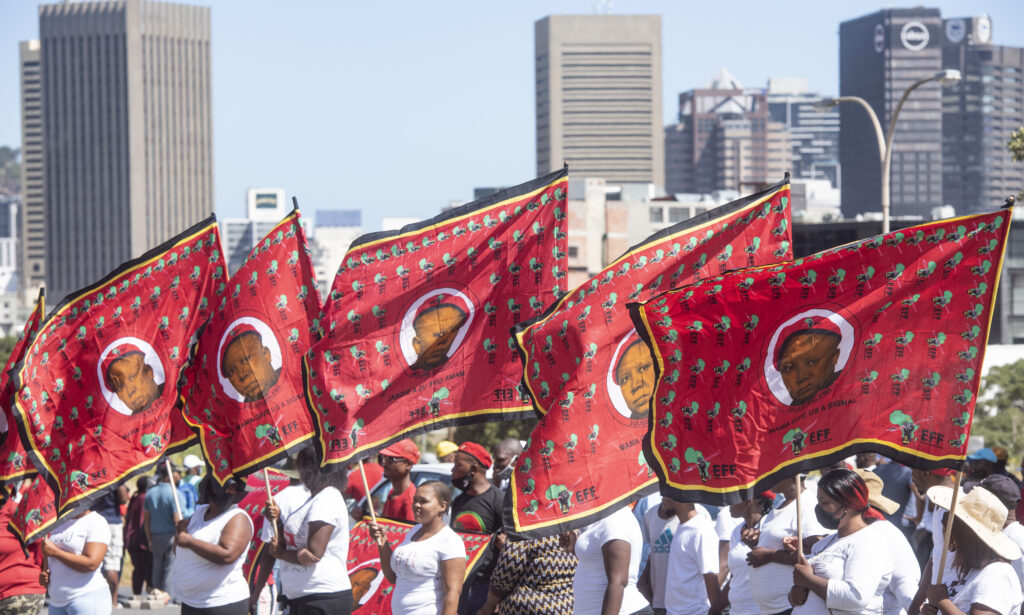
I’ve often thought that many name change critics approach the debate with a certain intellectual dishonesty. Most of the time I hear that South Africa should not change a name of a city, road, river or geographic region because of the “cost” involved. Critics will usually juxtapose the cost of the name change with how many houses could be built or starving children could be fed. It’s emotive and even true, but misses the point entirely.
I think it’s time for some honesty. Search your feelings and come out with it. Say you don’t want a name changed because you believe that history should be preserved or you think it runs counter to reconciliation in South Africa. Or maybe you are just the nostalgic type. These are legitimate arguments. But don’t waft on about how costly it is, because that’s the small picture.
In any case, critics who push the cost argument don’t really know the price we pay relative to the government’s overall spending budget. I’ll bet it’s fractional, even insignificant in the bigger picture. Maybe it’s a big deal for a small economy like Burkina Faso, but not for this middle-income country.
But more importantly, surely the money is worth it? For the cost involved, will a name change not inculcate pride and patriotism for hundreds of years and many generations of South Africans to come? How can you put a cost on the positive psychological effects this will have on the nation? By renaming a village, town or street after a local hero, we are creating role models and a sense of ownership. And even better if it’s a particularly offensive name like that of an apartheid architect that is changing. For what we are getting at this “cost”, it’s a steal.
It is nothing short of bizarre that South Africans on a daily basis have to drive up and down roads that continue to evoke painful memories of apartheid or colonialism. Many names must change. There is no debate here. However, the process should not be wanton, but be collaborative, empathetic and strike a balance between the new and historical. Such a balance can be achieved that serves all sectors of our diverse country. And that will be money well spent.
For the record, I don’t think the name Grahamstown should be changed. It’s a relatively innocuous, neutral name that has taken on new meaning and been subverted in the modern era. It’s an entirely different proposition to, let’s say, Verwoerdburg. And I’m not saying it shouldn’t change because it will be too costly; I don’t want it to change for nostalgic reasons — it’s part of my own history. And I don’t want that to be deleted. But that’s just me.


The name change issue has been looming above us all. Simply because its had a such a profound presence in debating circles. I however think that its grievances are both the cost factor and the historical. Regardless of how little the cost may be South Africa has a large and growing amount of citizens bordering on the poverty line. The name change is not cheap process, News24 reported that the change from Pretoria to Tshwane cost an estimated R1 bn. Now how many people could we feed with that amount? Or more topically how many more cots could we have provided for the babies in cardboard boxes at Baragwaneth Hospital?
As much we try and hide it and however painful it may be, apartheid is part of our history. Fair enough loose the real derogatory names, but why remove the entire country of its history. We should be proud of how we’ve progressed, look at the old names and be inspired of the capabilities South Africa has. The new generation needs to be aware of what happened in our history, lets leave the opportunity to learn from historical mistakes open. South Africa has a growing infrastructure, why not just name those after our apartheid heroes.
Was Yusuf Dadoo and Ruth First the only white and Indian activists…but lets not racialise issues any more than we should.
The name changes is a very sensitive issue to most people,if the town names should or should not change must depend on the citizens votes.
Name changing is a waste of time and money.what difference does it make. The plce is not moved ,its not given any special treatment atleast why not spend too much money in developing that certain area.
I think the new South Africa has to have a capital that is african not colonial. So Pretoria has to go. I live in Durban and have a book on the street names. Some pepole who were ‘nothings’ got streets named after them. eg Smith street. Others got 3 or 4 streets named after them. Let’s spread the history around a bit. However, why OR Thambo is remembered ahead of Jan Smuts beats me. Both were great statesmen and deserve to be remembered. Also leave something important for Mandela.
Just a thought. He who fathers the baby should have the privelege of naming it. Who built the towns in Africa? Renaming them does not hide their European origins.
I really don’t see why we have to change names all of a sudden. Perhaps the cost argument is a petty one, perhaps not. Fact remains that it does cost a bit of money to have all these new names implemented.
The emotional argument is also a good one at times. People attach strong significance to names. Why not just change one or two names instead of every single one they could find?
Those names were given for a reason and I think we in South Africa should, in the spirit of reconciliation, be sensitive towards that.
Changing all the old names will alienate a large percentage of this country; not changing the names will alienate an even larger percentage of this lovely country of ours. Where do we draw the line?
Mahreen: How many people could we feed? When the costs are calculated for name changes, those costs generally are calculated on the basis of what it would cost the government(s) AND the private sector in terms of advertising, stationery, etc. If the private sector saved that money, do you think those funds would go into feeding people or building houses?!
The “new generation” needs to be aware. They should read books and visit museums and watch movies that makes them aware. Living on a street named after an Apartheid dictator does not make one aware of anything. And by the way, Mahreen, your appreciation of “indian” and “white” activists seems quite limited. Or, perhaps, your knowledge of street names is. A number of other “indian” and “white” activists have also had streets named after them.
Joy-Mari: “Those names were given for a reason and I think we in South Africa should, in the spirit of reconciliation, be sensitive towards that.” Of course those names were given for a reason, often to recognise some great figure who played an important role in the oppression and dispossession of Black people.
Owen, OR Tambo is “remembered ahead of Jan Smuts” because OR played an important role for the liberation of this country and all its people (even though all its people are still not liberated and even though many White people might not realise that the end of Apartheid is their liberation too). This constant attempt to present some kind of equivalence between the oppressors and those who fought for justice is, frankly, nauseating. OR and Jan Smuts are not equal! Both were NOT great statesmen! One presided over oppression, exploitation and dispossesion; the other fought to liberate his country from these crimes.
And the constant beating of people (especially Black people) with this stick of “reconciliation” is getting tiresome. Reconciliation does not mean Black people, who have been oppressed for centuries, have to pretend like they now love and admire their oppressors and want to recognise them by naming places after them. Reconciliation does mean, however, that White people should recognise Black suffering and they should agree, in the spirit of reconciliation, to remove names of people who have contributed to that suffering and have caused the enormous hurt that characterised Apartheid. Let’s see some reconciliation from the other side!
I agree, great and timely article.
Cost is NOT the issue here. Stationery needs reprinting and signs need replacing eventually anyway and these costs are not relevant in the context of our greater national budget.
What is perhaps the greater issue is the attempt to erase culture and history by changing names that have little or no bearing to apartheid. What could the possible motivation be here? Reconciliation means aligning the needs of both sides. One can only surmise therefore that changing neutral names is an attempt to impose one culture on another, the one that gave riswe to the very thing being renamed.
Another point, colonial expansion was practised by many in this country, including the Nguni arriving from the north to colonise lands held by the San. Colonialism was the way the earth worked hundreds to thousands of years ago. Erasing European names is as senseless as erasing Nguni language names and replacing the whole lot with San names.
So lets change the hurtful names and leave the cheap digs, taking this arguement way back into history exposes it as weak at best.
When debating if money on name changes has bee well spent, I think it is important to question
whether you have indeed spent a cold,hungry and lonely night on the street. How could you then imply that the millions of rands are better spent in an attempt to erase a list of names which exists regardless of whether they are acknowledged or not, when compared to lives saved and enriched. Not just by some abstract sense of belonging or inspiration of a long lost role model, but by a warm shelter,away from the winter chill; a (daily) nutritious plate of food; a place to call your own. So you see the “cost argument” critics do not see this from a political,”larger picture” point of view…we see people starving, homeless and jobless. We recognise that the “small cost” so boldly mentioned could save a very great amount of lives, TODAY. What use are the “psychological effects” of tomorrow,when there is so much more to be done today.
We live in a country where 50% of our populous is unemployed, and therefore powerless to change their lives for the better,or build great futures for their children to enjoy this new free nation we are trying to build. And what about the percentage of people who are employed,but struggle to carve out a life on a minimum wage. A minimum wage that I am sure most people will no doubt scoff at in utter disgust. Although I agree that there are many unsung hero’s that deserve to be recognised and praised for the very important roles that they played in creating freedom for the oppressed,and equality for the downtrodden,a voice for the unheard, I feel that there are so many more “real life changes” to be made in this country, that spending money on changing the way history reads, on the surface, is overshadowed. I had hoped that our Government, which was suppose to be for the people, would look beyond political gratification and see the real issues that need to be dealt with. People are dying; hungry, homeless, hopeless…How much money and genuine effort are they being allocated in our “over all spending budget”?
Yes, Grahamstown is a very neutral name, given that it was named after Lt John Graham who used the town as a post while doing a little ethnic cleansing among the Xhosa.
Is it an offensive name? Perhaps, but just like H.F. Verwoerd, it’s part of our history. We do not need the names changed, because if we forget our history, we are doomed to repeat it.