The pace of change and technological evolution has accelerated greatly over the last decade. It’s not only remarkable how dramatically the technologies in everyday use has changed, but also how easily society as a whole has adopted these innovations.
The adoption of these technologies has been unequivocally positive – for individuals, the business environment and society as a whole. This has been achieved through the liberation and democratisation of information and of technology.
Essential to this transformation has been the widespread proliferation and access to Information and Communication Technology (ICT). The impact of ICT can be grouped into three categories: economic, business and social. The three are interrelated, based on the fact that what happens in each of them is both cause and consequence of what happens in others.
However, ICT within a South African context has found itself behind the curve both globally and compared to the rest of the African continent. South Africa has lost its status as the continental leader in internet and broadband connectivity. Pricing of services and equipment remains a significant barrier to the expanded use of ICT.
Additionally, policy constraints, weaknesses in institutional arrangements, conflicting policies between responsible departments, regulatory failure and limited competition have all contributed to this fact.
Regardless, for those who have access, ICT in South Africa will continue to transform economic and social activities, as well as how individuals and communities communicate and function in our country. ICT’s impact on each sector of our society and each area of service delivery will depend solely on how uptake is addressed in the coming years. A single cohesive strategy is needed to ensure the diffusion of ICTs in all areas of our society and the broader economy. Just like energy and transport infrastructure, ICT can also be seen as an enabler. It can speed up delivery, support of analysis, build intelligence as well as create new ways to share, learn and engage one another.
According to the National Planning Commission (NPC), by the year 2030 ICT will underpin the development of a dynamic information society and knowledge economy that is more inclusive and prosperous. This will be based on a seamless information infrastructure which will meet the needs of our citizens, business sector as well as the public sector – achieved by providing access to the wide range of services required for effective economic and social participation, both at a cost and quality which is at least equal to South Africa’s competitor nations.
Within this vision that the NPC maps out, the underlying ICT infrastructure and institutions – referred to as an “info-structure” – will represent the core of a widespread digital communications system. This ecosystem of networks, services, applications, content and innovation will attempt to support economic growth, development and competitiveness, create decent work, and contribute to nation-building and social cohesion as well as local, regional and national integration. Public services and educational and informational products will be accessible to all in our country. The tangible outcome of this vision will be creating improved human development in South Africa premised on the creation of an e-literate public which has the power and advantage of technological advances to drive their demand for services and hold their government and elected officials to account.
In addition, with the added benefits of technology and ICT as the enabler, and multicasting and instant online translation, the digitisation of content and ICT applications will also make it simpler and easier for our citizens to be able to communicate and obtain information using different languages. Innovations such as mobile government services – delivered through mobile phones – will grow and converge with more traditional e-government services which are already in existence. ICT proliferation and adoption will also have the potential to reduce spatial exclusion, thus enabling seamless participation by the majority of our citizens in the global ICT system – not only as users, but also as developers of content and applications, business process outsourcing and innovators.
However, a major stumbling block to this utopian vision of a digitally connected South Africa remains the growing fissure of the digital divide. This refers to the gap between those who have access to service and the demand from those who are excluded by unavailability or prohibitive costs. When analysing the nature of the digital divide in South Africa, a distinction must be drawn between the real access gap and the market efficiency gap. The real access gap refers to households or individuals who can be reached only by providing permanent subsidies or some sort of support. The market efficiency gap refers to the difference between the share of households reached in an efficient market and what is actually achieved under existing conditions.
As a potential solution to the digital divide in our country, a more competitive efficient market and effective regulation that enables operators to meet the demand for affordable services, reducing the number of households or individuals requiring support must be implemented.
Improving equitable access to enhanced ICT services in South Africa will also require implementation to stimulate demand. At the most fundamental level, strategies are needed to improve e-literacy through basic and secondary schooling, tertiary, adult education and supplier training. These types of initiatives will support the production of multilingual, relevant and local content for public programming and information services, including education and mobile government services and applications. This would ensure that ICT will be able to deliver content and applications which are relevant to the needs of the wider community in our country.
ICT can be used as a tool to fight poverty, increase employment, education and encourage entrepreneurship in South Africa. In addition, by providing universal access to ICT in our country, citizens in our most rural areas of South Africa will not need to call their municipality or even go to home affairs or social welfare. They will be able to do everything online. That’s the true promise of technology in South Africa: making our citizens’ lives better.
Author

A prince with dignity and determination
Prince Ngarambe’s goals are to become Rwanda’s first transgender model and to uplift the country’s youth

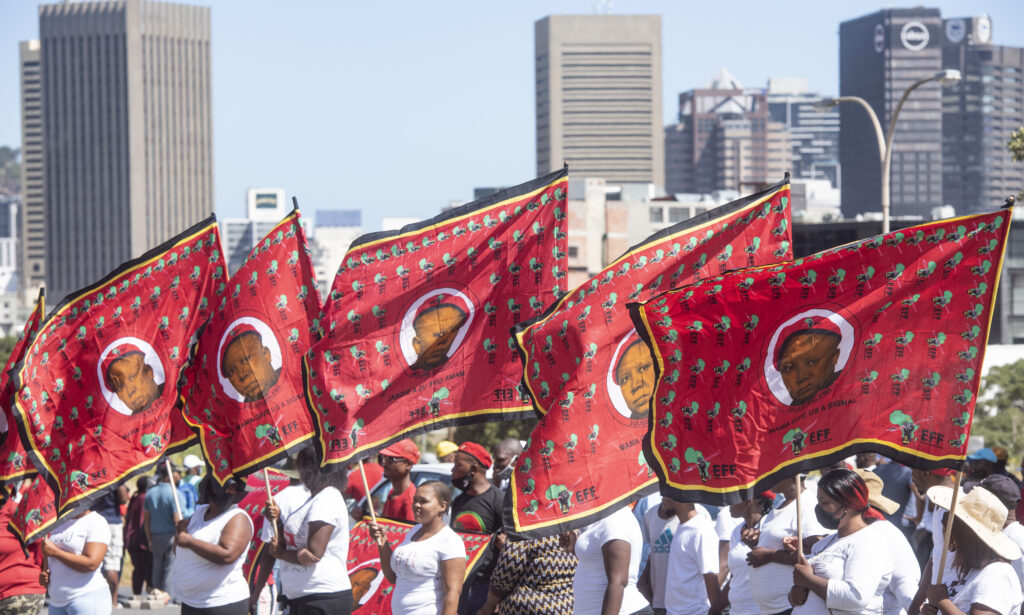
The EFF’s principles are unshakeable
Unlike the ANC, the core values of the freedom fighters do not change with each leader it elects