Do we need to bring the silkscreen poster back?

“The purpose of engagement,” said Kate Philip to a small but packed lecture theatre at UCT’s Hiddingh Campus this weekend “is to change the world, a world that is shaped by power. Power itself is not random, it is organised, and therefore to tackle forms of power, one must be organised as well”.

This was an interesting comment coming from someone who was head of Nusas at the height of the anti-apartheid struggle in the early eighties and now works alongside the presidency. Philip was addressing those students currently at UCT who head up various projects that, in differing ways, fundamentally attempt to address the inequality of South African society. Most do so through tutoring interventions in under-resourced high schools in the broader Cape Town area, some through medical services or legal advice, and others through art and music.

Each week, more than 1 000 students descend from the slopes of the university and attempt to define and address the amorphous “enemy” that has taken the place of the apartheid government in terms of student activism, action and attention in the past decade. There are no longer caspers in the streets, the Constitution is humane; on paper at least, we are a democratic equal-opportunity society, but it is very clear to anyone who cares to look that the battle for equality is by no means won.

And so …

From Friday to Sunday, 70-odd students came together to talk and to think with an intensity, a rage and an enthusiasm that will, I suspect, make many ripples in the coming period. Titled “Students in/and Community?” the conference opened up a space for critical reflection on core issues that face all students in South Africa today, but particularly those who leave their campuses to attempt to teach, to share skills and to build the resources of underprivileged areas. Though the conference was focused on UCT, students attended from CPUT and UWC, and delegates came from throughout SADC as well as the US, Bangladesh and UK.

The conference was organised loosely around four core themes and included presentations from civil society, academics, government, the professions and recent graduates, all with question and answer sessions. Students then broke into small groups to discuss and debate the presentations and the ways in which they spoke to the practical challenges and theoretical dilemmas facing students in South Africa, before coming back to the plenary to continue to unpack the implications and possibilities that are opening up at the current socio-political moment.

The first theme was that of engagement. How do we engage? With whom? How do we choose? What does it mean to engage? The principal of a primary school in Ocean View spoke of a wall that they have recently erected to help remember all their pupils who have died while still at school. A wall for dead children? Do we live in a war zone? Well, yes, in fact — some of us do. The principal was very gentle, very patient, and very enthusiastic about the energy and willingness of students. She did have one request though, and that was that before students come to Ocean View and other areas, they do just a little of that magnificent research that takes place within universities. They need to make sure they understand why there is such a wall at the school, and what that might mean for the children who sit quietly painting in the afternoons. They need to have a sense of what they will be able to achieve, and what it would take to achieve more.

One of the conference delegates made the telling comment that his high school prepared him for university, but not for being a South African. It was only through his work in various spaces beyond the southern suburbs that he began to understand what being South African really meant with all its ambiguity, complexity and historical undertones. But rather than learning through interaction with people in places like Ocean View, should this preparation not be the role of universities? Being South African, of course, is also attending places like UCT, so how do children from that primary school grow up to get there?

The second question that was explored at the conference was that of cooperation. Students themselves play a relatively limited role in society, as their skills are limited and their attention often divided between studies, activism, socialising, work, family and other interests. There are organisations both within and external to UCT, however, who can form partnerships with student projects that capitalise on the time that students have and assist them during the freak-outs that occur when a first-year English and Art History major finds herself in the position of needing to create the financial policy documents of a mid-size teaching organisation. How to find those organisations? How to link with other students? How to overcome political, personal or inter-project differences in order to teach better or build better houses?

Then there is the issue of the curriculum. What students are taught at university filters throughout their lives. If graduates emerge who are conscious of their privilege and committed to using it with integrity and for the betterment of society, then South Africa can look forward to the full working lives of thousands of individuals devoted to addressing injustice. While it is perhaps challenging to shift the status-quo, it is not impossible. Almost every discipline has practical application, and the conference marked a moment for students to think deeply about what and how they are taught, and whether or not there is overlap between the lecture hall and the outside world. The space of the university, it was stressed again and again, is one of ideas — and students need to occupy those ideas, demand that the ideas they are presented with are those with which they can ethically live and ensure that the ideas inform a desirable future.

Finally, the conference addressed the question of transformation. Often a topic that is skirted around by students, the new dispensation both academically and politically has called strongly for a reconsideration of this process. Listening to the discussions emerging over the weekend, it was refreshing to hear the nuance of student’s arguments for and against, for example, enforced “representativeness” in committees. It was clear that diversity is no longer simply that of skin colour but of background as well, of socio-economic status, of political affiliation, of religious or ideological bent and of patterns of thinking. Transformation entails a move from homogeneity to multiplicity. It involves the inclusion of languages and articulations that are not simply questions of speech but also of comportment and of thinking; it involves linking social circles and geographic space, not moving in separate arcs around each other in the same small room.

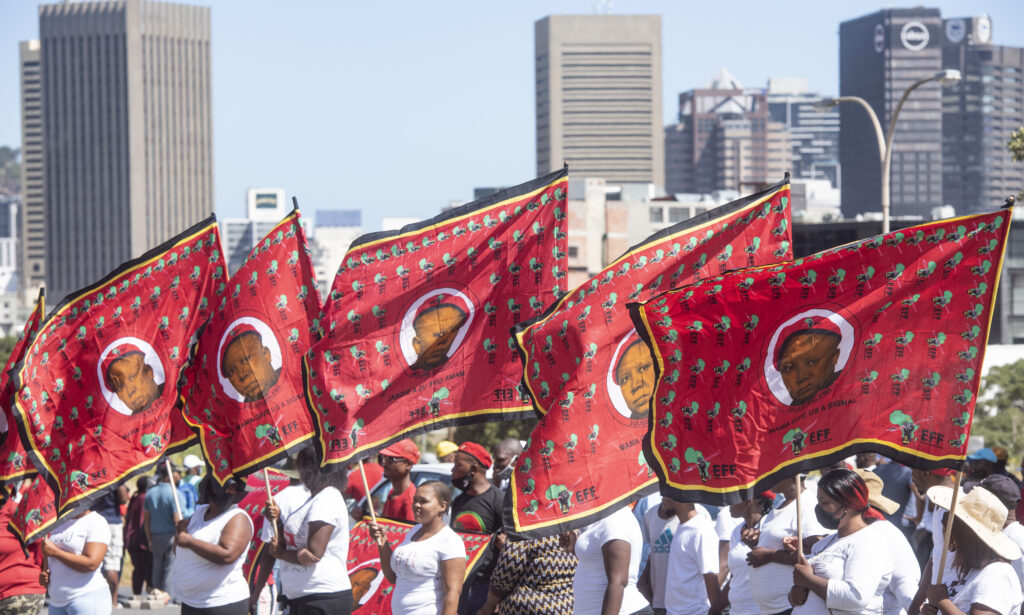
Is there a difference between the activism of the eighties and the volunteerism of the present? By volunteering instead of acting, are we ultimately shifting responsibility for delivery onto the government, because it should, or are we saying that militancy must be replaced by a willingness to listen? Do we need to bring the silkscreen poster back? Could such a poster help the thousands of eager young people with little chance of viable employment “trickle up” to bring their insight to a changing university on the side of the mountain? What else do we rely on to instigate real change?

Intelligent and careful thinking is essential when trying to organise and trying to define and work either with or against those who wield power. We were lucky, with this conference, to receive support from the highest levels of the university. Max Price, the vice-chancellor, spoke of the need to produce graduates who are socially responsive, engaged and aware. Jo Beall, the deputy vice-chancellor in charge of ensuring that this actually happens, chaired the transformation session. Both took many questions and listened carefully. Whether or not that will contribute to significant change remains to be seen, but it certainly showed that it is still possible to imagine a slightly different world. Varkey George, the man largely responsible for shifting the Students Health and Welfare Centres Organisation from a charity-based initiative to one that focuses on sustainable development and skills-sharing, made the pithy remark that a recognition of the value of science and technology got humans to the moon, so surely a recognition of the value of social entrepreneurship and unselfish living might get us at least an equalised education system. He suggested what we need to cultivate is a Richard-Branson-and-Mother-Theresa combination. The progeny of that would be quite astounding, but by no means impossible to conceive.

24 Responses to “Do we need to bring the silkscreen poster back?”

  1. Benzol #

    I would have liked to be a fly on the wall.

    I sincerely hope that the demographics were representative of the SA society. If so, there is hope for the future.

    Thanks for sharing this with me (us).

    July 27, 2009 at 8:59 pm
  2. OneFlew #

    Charitably: what has NUSAS done for us lately?

    Uncharitably: what has NUSAS ever done for us?

    July 27, 2009 at 9:46 pm
  3. Judith #

    At last a well thought through article that indicates that students are back on the path of changing the world! Well done and keep on with your critical and questioning thought processes.

    July 28, 2009 at 12:50 pm
  4. NUSAS no longer exists, to answer OneFlew’s first question.

    Regarding the second, for some of us it was an important stepping-stone. I started university in 1982 – in fact I have clear memories of Kate earnestly persuading us of her case.

    But having recently survived two years of apartheid conscription, I found NUSAS strangely out of touch with what was happening in Namibia and Angola. In general, I found its leadership rather too focussed on the agenda of the “black” students’ organisations and dismissive of the majority of white students.

    Hence the meteoric rise of the End Conscription Campaign and its affiliates on campuses. In October there will be nationwide celebrations of the 25th anniversary of the foundation of the ECC.

    July 28, 2009 at 2:32 pm
  5. OneFlew #

    I think the launch of the UDF, and the campus visits of COSAS to NUSAS campuses, at that time showed the NUSAS crowd up for what they mainly were: the PFP of student politics complete with requisite adolescent dummy-spitting anger. Middle class, privileged, soft. And opinionated and messianic, obviously. A talking shop. The black kids had all the edge.

    Would South Africa today be any different if NUSAS had never existed? (i.e. What have they done for us lately.) Was the trajectory or timing of events changed one iota because of the existence of NUSAS? (i.e. What have they ever done for us.) I think not.

    Nice, inoffensive people with their hearts in the right places, but they mainly just weren’t the ones who made any difference.

    Would you buy a used Sociology paper from these people?

    July 28, 2009 at 4:49 pm
  6. Never mind a sociology paper, I am intrigued by Jess’s cryptic mention of Kate’s current “working alongside the presidency”.

    The ANC of today has historical continuity with that of the 1980s, but bears little resemblance to what NUSAS looked forward to.

    At least the ECC’s consistent anti-militarism laid the grounds for comments of the “I told you so” variety.

    July 28, 2009 at 6:01 pm
  7. Jeff #

    Maybe these students should help their fellow students up at UCT who can barely write an essay, and have little idea of how to study at university. The failure rate is abominable. First solve the needs of your own classmates, then maybe think of the community.

    As a former university student myself and later a staff member at a university I always found these student activists to be a “loud sounding nothing”.
    Running around trying to “make the world a better place”. These “communities” would be better off if they instilled some discipline in their kids and themselves and did something themselves to lift themselves out of their misery instead of relying on half-baked students who lack the experience in the real world.

    July 28, 2009 at 7:15 pm
  8. Jeff #

    All this claptrap of students being socially active is nothing but the age old “Town and Gown” debate for those who appear to be guilty to have had a better life than others less fortunate than themselves. That’s life everywhere; always has been, always will be.
    Most people will take what they can from you and won’t lift a finger to help themselves.

    July 28, 2009 at 7:27 pm
  9. Jeff #

    Building a wall to remember all those who died while still at school? Puhleeze!

    Rather teach them:
    “The moving finger writes, and having writ moves on. Nor all thy piety nor wit shall lure it back to cancel half a line. Nor all thy tears wash out one word of it”.

    Teach them the meaning of those lines. Far more use to them in the real world than a “Wall of
    Remembrance”.

    July 28, 2009 at 7:38 pm
  10. Andrew #

    If NUSAS had not played a role in exposing the evil of apartheid to white students, then would business leaders who emerged from the universities have engaged with the ANC? Would the ECC have been able to operate effectively without the support of NUSAS SRCs? Would white professionals have been prepared to give democracy a chance, or would even more of us have left the country in fear of the “communist” takeover? Would ANC/UDF activists have been able to live in appartments in designated “white” areas rented out in the names of students?

    Certainly NUSAS had many weaknesses, but for many of us it was the only accessible dissenting voice in the ideological hegemony of apartheid. Thanks Kate and the others who made sacrifices and took risks to help in a small way to build the democracy we enjoy today.

    July 28, 2009 at 8:44 pm
  11. Duncan #

    @Jeff

    I agree with your comment about helping fellow students at university. However,the reality is that there are very few students at university who are capable and even fewer that are also willing to volunteer to help fellow university students.

    People who are willing and able to help school learners are far more numerous. It’s better to make use of these volunteers and make at least some difference, than to do nothing at all.

    I cannot help but feel you’re being a bit of a hypocrite in your paragraph about “loud sounding nothing” half-baked activists. Maybe if you actually got involved in a community you’d spend less time trolling and actually make a difference in people’s lives.

    July 29, 2009 at 10:29 am
  12. OneFlew #

    Sorry Andrew, I know it’s tempting to attribute relevance to people one likes, but NUSAS simply didn’t have the impact you suggest.

    The business leaders who engaged with the ANC were mainly Afrikaners who wouldn’t have known NUSAS from Adam. And those who were English-speaking didn’t do so in consequence of any socialisation by NUSAS; they were mainly by some considerable margin the elders and social superiors of the students.

    And the ECC didn’t change anything either: conscription continued until it ended and the ECC didn’t change that outcome at all.

    Ditto having people living in areas that weren’t “designated” for them. The Group Areas Act was repealed for reasons entirely unrelated to how many activists clandestinely lived in Obs.

    NUSAS wasn’t the only credible dissenting voice accessible to a student. If you spent any time on (say) UCT campus at that time you could easily have encountered people who had a very clear and coherent set of dissenting opinions. Some of them were even fairly active (e.g. within SALDRU or the Sociology Department; not, as I recall, in the Anthropology Dept). The Politics dept was liberal rather than left as I recall, but it still “dissented” coherently.

    The NUSAS leadership, a few of whom I knew very well, didn’t enlighten me; they simply weren’t of that calibre or experience. (They were just like oneself, except when less bright, but with vastly bigger egos!) Unlike some of the academics.

    July 29, 2009 at 10:42 am
  13. Markus #

    @Jeff:

    I agree that students at UCT might use their time more constructively helping their fellow ‘students’ (enrolled at UCT and not) with basic life skills, such as literacy, but I think there is also space for greater, broader engagements, such as this workshop. Congratulations to Jess for organizing the event (and for adopting a more accessibly and less uppity tone than in previous posts!). Continue to live this philosophy of engagement. My experience sadly tells me that students tend only to engage in fleeting, knee-jerk ways about issues that need to be focused and committed to. One must tackle power slowly…

    July 29, 2009 at 11:39 am
  14. Jeff #

    @Duncan
    I am involved in a primary school that has about 95+% of learners from Khayalitsha and other African townships. I take part in a literacy programme that had improved pass rates from about 30% to over 80% at Grade 3 as tested by the WCED. I have started and run a library at the school where I try to augment the literacy programme and teach some life skills as well. I love the interaction with the kids and most of them seem to enjoy it too. Perhaps they see me as a positive male figure in their lives who doesn’t scream and shout at them to get things done. I hope so anyway.
    However, my experience of student activists wasn’t always positive. I also have a problem with a lot of academics, to many of whom have some sort of textbook approach to solving practical problems. This is often because they have gone straight through varsity from Fresher to Professor without having worked in the real world.
    There are plenty of students at UCT who could help those who had a less privileged education than themselves. They must see every day how they struggle. They’d rather feed their own egos by attending seminars about “Ways of knowing” and such sociological claptrap.

    July 29, 2009 at 5:33 pm
  15. @Andrew: Far from relying on NUSAS, the ECC overshadowed it, at least on the campuses I was familiar with. Insiders reported NUSAS leadership discussing the “ECC threat” – i.e. mobilising more activists and getting more profile.

    @Jeff: So, in your book, for the ECC to have achieved anything, conscription would not have “continued until it ended”?

    In a way, that was the case: as the numbers of non-reporting conscripts increased geometrically to the point where the military police no longer tried to enforce the law.

    For more than 3 years before conscription was abolished, even those publically refusing to serve were left alone, rather than inflicting politically costly trials on them. That political cost resulted from support campaigns.

    July 29, 2009 at 5:35 pm
  16. Jeff #

    Anyone who has ever opposed any power structure knows that you have to be organised. It doesn’t take a university education to know that. You learn that pretty damn quick if you want to survive.
    Kate Philip and her ilk at NUSAS may have had their hearts in the right place, but as an organised opposition to the apartheid power structure they were pretty damn useless. As in fact were the ANC and the other struggle organisations. Any well organised revolutionary structure would have overcome a few white racists much quicker than the ANC, SACP, PAC eventually took. They relied to much on thinkers, not doers. Too many blacks were afraid to make the “ultimate sacrifice”. I’m sure Lenin would have been appalled. Russia would still be under the Tsars if the Bolsheviks were as incompetent as the ANC and MK.
    Opposing power structures is relatively easy compared to dealing with power once you achieve it, because someone is going to be opposing your power structure.

    July 29, 2009 at 5:50 pm
  17. Markus #

    @ Jeff:

    “They’d rather feed their own egos by attending seminars about “Ways of knowing” and such sociological claptrap”

    I admit, I tried really hard not to agree with your rather pessimistic view of Jess’s project, but there is something disturbing when you read your account of teaching in Khayalitsha against the other posts in the blog. Do you think it’s a middle-class luxury to be able to ask such daft questions?

    July 29, 2009 at 10:14 pm
  18. OneFlew #

    Michael Graaf, I think your ECC point was in response to me?

    Conscription was always enforced at the level that suited the government.

    There may at the end have been some leakage at the margins. I don’t think this worried the Nats; they had halved the length of the conscription period by then, had stopped calling people up for camps and had stopped sending them into combat.

    The scaling down and termination of conscription happened for reasons quite unrelated to the ECC.

    July 30, 2009 at 12:25 am
  19. OneFlew #

    “They’d rather feed their own egos by attending seminars about “Ways of knowing” and such sociological claptrap”

    I generally agree with the critical comments made. Of course it’s mainly claptrap and of course it’s a complete ego trip.

    It is however better to have a society where some bandwidth is devoted to this sort of thing than one where it does not exist. There are grains of truth and degrees of perspective and understanding that can be uncovered by this sort of dialogue.

    The balanced person would be one who possesses a bit of that perspective.

    Regrettably I suspect that the way SA society is configured is that you have a crowd of people who do only this, and know little else, and a crowd who know none of this and have to deal with the real world. And never the twain shall meet.

    So it may be a problem of redistribution, to be added to SA’s long list of redistributive needs.

    (At least I’ve done my bit: one of those redistributive needs was for people like me to be redistributed to Europe…)

    July 30, 2009 at 2:13 pm
  20. Vic #

    Jess I find this post disheartening, your agenda against power is ‘n mirage and totally misplaced, your only achievement will be to instill the kind of pessimistic, anti-everything, including self, attitude that is so pervasive at universities.
    Power is within everyone – not out there. If you want to help a child or young person empower him/her with skills. I shudder to think what you lot are going to do to the poor youth – ram Chomsky or Freud and Humanist bull into their skulls? You do more harm than good.
    Here is how I empower the disadvantage. I run a course which I give at home in the center of Cape Town 3 nights a week, after my day job from 18h00 to 22:00, every 2nd Saturday 10h00 to 14h00. It is free.
    The prerequisite for a student is English second language (like me) and with grade 10, 11 or 12 – and 18 years old. The first class starts with “This is where you switch on a computer”.
    Midway through (say 3 months later) “Now you know everything about Windows, Word, Excel, PowerPoint, Outlook”. (God bless Bill Gates). After a couple of months you end with “Now you are a Web Developer and know HTML, CSS, Photoshop & Dreamweaver”.
    Then you get the young person a job in a “powerful” company. Then you sit back and see them get

    July 30, 2009 at 4:51 pm
  21. Jeff #

    @Michael Graaf
    I never mentioned the ECC. Never knew much about them.

    July 30, 2009 at 5:35 pm
  22. Jeff #

    @Markus
    The kids are mostly from the townships but the school is in Observatory, Cape Town. Funny thing is there are now well over 200 volunteers and we have expanded to four other schools in CT. These volunteers are almost exclusively middle class/upper middle class white women. Their dedication to the project is incredible and their rapport with these disadvantaged kids is fantastic. I think one can only really understand black people when you interact with them in a close relationship. Unfortunately this was denied to us by apartheid. I tell my black friends that I can never be black so I am willing to take their word when they tell me that they face racism every day. However, I am also able to point out when whites’ behaviour isn’t racism, it can be just a white cultural thing.
    Incidentally I come from a very poor working class background in the UK. My father was a coalminer and my mother a domestic worker (when she had work). I do sometimes have a problem with middle class people’s patronising attitude towards black people.

    July 30, 2009 at 5:49 pm
  23. My apologies for addressing the response to OneFlew’s “conscription continued until it ended” thesis to Jeff.

    Despite trying ever since reading OneFlew’s statement, I have still been unable to think of anything which didn’t, or doesn’t, continue until it finishes!

    July 30, 2009 at 7:57 pm
  24. cuckoo #

    Well this is continuing even though it has finished!

    March 21, 2011 at 2:23 am

Leave a Reply

 characters available