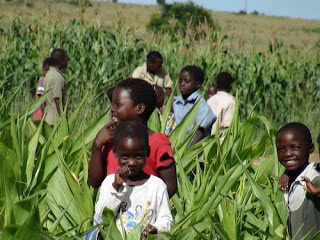
Zambian farmers lead the way

In the US, it seems like we only hear about what’s going wrong in Africa. We see and read stories about famine, HIV/Aids, disease, or conflict.

In fact, few Americans will ever step foot in countries like Malawi or Zambia, largely because our media often scares people away.

As I travel across Africa, working as a senior researcher for the Worldwatch Institute as co-project director of Nourishing the Planet, I am hoping to show a different side of the continent.

Instead of stories of despair, we are looking at and sharing stories of success and hope, highlighting African-led innovations that are helping to alleviate hunger and poverty in an environmentally sustainable way.

After spending time in Lusaka meeting with non-governmental organisations, non-profits and projects on the ground, I discovered that this country is filled with incredible individuals and organisations — making my job very easy, and in many ways serving as a model for the rest of the continent.

Here are some examples:

Comaco, an organisation founded over 30 years ago to conserve local wildlife, helps farmers improve their agricultural practices in ways that can protect the environment — such as through conservation farming — while also creating a reliable market for farm products.

It organises the farmers into producer groups, encouraging them to diversify their skills by raising livestock and bees, growing organic rice, using improved irrigation and fisheries management and other practices so that they don’t have to resort to poaching elephants or other wildlife.

The United Nations World Food Programme’s Purchase for Progress (P4P) programme, with funding from the Bill & Melinda Gates Foundation, the Howard G Buffett Foundation, and the Belgian government, is working with the private sector, governments and NGOs to provide an incentive for farmers to improve their crop management skills and produce high-quality food, create a market for surplus crops from small and low-income farmers and promote local processing and packaging of products.

Mobile Transactions, a financial services company for the “unbanked” in Zambia, allows customers to use their phones like an ATM card. Over the last decade, cellphone use in Africa has increased fivefold and farmers are using their phones to gain information about everything from markets to weather.

By using Mobile Transactions, farmers are not only able to make purchases and receive payment electronically; they are also building a credit history which can make getting loans easier.

And Mobile Transactions also works with USAid’s PROFIT programme to help agribusiness agents make orders for inputs, manage stock flows and communicate more easily with agribusiness companies and farmers.

Perhaps most importantly, the partnership helps agents better understand the farmers they are working with so that they can provide the tools, inputs and education each farmer and community needs.

Care International’s work in Zambia has two main goals: increase the production of staple crops and improve farmers’ access to agricultural inputs such as seeds and fertilisers. But instead of giving away bags of seed and fertilisers to farmers, Care is “creating input access through a business approach”, not a subsidy approach, according to Steve Power, assistant country director for Zambia.

One way they’re doing this is by creating a network of agro-dealers who can sell inputs to their neighbours as well as educate them about how to use hybrid seeds, fertilisers and other inputs. At the same time, “we are mindful” of the benefits of local varieties of seeds.

Jan Nijhoff of the Common Market for Eastern and Southern Africa (Comesa) and Michigan State University, who is also an advisor on Worldwatch’s Nourishing the Planet project, says Comesa’s mission is to promote regional economic integration through increased co-operation and integration of trade, customs, transport, communication, technology, energy and gender, as well as agriculture, environment and natural resources.

Throughout most of my meetings, a theme I hadn’t heard as much in other African countries continued to surface — linking farmers to markets.

Though at times I was sceptical about this focus on the private sector, the more I talked to farmers, NGOs, development workers and policy-makers, the more convinced I became that farmers need not just inputs to grow their crops, but a profitable — and sustainable — market to sell those crops.

In developing this model, it’s clear that Zambia is leading the way and creating examples that could work and be scaled up in other countries across the continent.

www.nourishingtheplanet.org

50 Responses to “Zambian farmers lead the way”

  1. John #

    Well written article.

    You don’t need to do much research to spot Zambia’s amazing recovery, just look at their economic statistics.

    I believe that a big part of Zambia’s success is that power changes hands at elections. They then attempt to hold the ousted politicians accountable for their actions. They fight corruption, particularly when perpetrated by the ex-President.

    They were also never cursed with despotic freedom fighters the way South Africa and Zimbabwe have been.

    We need to hold Zambia up to all South Africans as an example of what a successful African Nation can do for its people

    April 28, 2010 at 1:43 pm
  2. X Cepting #

    What a brilliant, information-rich, hopeful article. Why can these principles not be applied in South Africa, or are they? One person I spoke to that did work for an NGO here, with the same purpose of education and funding of farmers, left in disgust because the major beneficiaries of overseas donations were the NGO organisers, not the farmers.

    April 28, 2010 at 2:24 pm
  3. marxism sux #

    The problem in the broader SADC region is that agriculture is not synonomous with food production but rather with 1) anti-settler (white) campaigns, and 2) BEE oppurtunism/mass self-enrichment – to the point that we recently saw the likeable Grace Mugabe removing a senior ZANU PF oligarch from a commercial farm in order to further swell the Mugabe billions. The article also fails to mention that while subsistence farming is slowly progressing into quasi-commercial farming, there is a vibrant commercial sector which tacitly lends market-related support (along with aid organisations – who for example are not welcome in Zim!) to the emerging sector – ie: a commercial sector based on non-racialism and aimed at keeping the Zambian population fed. In short, Zambian authorities have learnt that land can be perhaps used in the short term to garner votes, but in the long term hunger is a powerful state which can topple any regime – watch Zim, and then watch SA – THE CLOCK IS TICKING….

    April 28, 2010 at 6:54 pm
  4. RogerP #

    Getting rid of Kaunda was the first step. You only have to compare the copper mines when nationalised and re-privatised to see what happens when politicians are kept out of the business arena.

    April 28, 2010 at 7:46 pm
  5. Lawrence Maumbi Michelo #

    This is rather a good story.. It tells how NGOs are working to strengthen the market. The big question the author forgot to ask. How does WFP raise its resources? How does it raise it money that it uses ? The same goes for Care International or any other NGOs for that matter. By marketing negative news of the African peoples and continent. Very bad indeed. These organisation have stolen the place for private sector proper and running programmes from that do not help the African image in the international arena. They thrive on negative news on the continent. Not that negative news is not there, they blow it out of proportion with a goal to raise money. And exaggerate it to light hearted western mind. The author fits in their equation. Selling to the west, the purported good outcomes of their intervention… America is not run on charity

    April 29, 2010 at 8:52 am
  6. Graham Johnson #

    The west is helping Zambia and they love it. Why do we not see similar responses from Zimbabwe and SA?

    April 29, 2010 at 9:08 am
  7. mike du toit #

    Can not some clever and influential person or organisation force Mugabe,Zuma and there hangers-on to read this and then write a test on it.Thoes who fail will be deported to the North Pole.
    Mike.
    ———————

    April 29, 2010 at 9:30 am
  8. Peter Joffe #

    We all remember how white farmers were kicked out of Zambia and the once bread basket became another basket case as has happened in Zimbabwe and now in South Africa.
    Perhaps the ANC will eventually wake up to the fact that food and water are the main resources and to burn down your own pantry is stupid. As soon as farming loses its racial colour the better. A good farmer is a good farmer and we need them. To turn productive farms into squatter camps is moronic. Land is important to the individual but it is more important to the state in that it must pay its way with people who know how to produce crops. If you give an man a stethoscope you do not get a doctor. The ANC is in any case so corrupt that we need a new, democratic and people caring party to take over. The ANC has outlived its time and their sell by date is long gone.

    April 29, 2010 at 9:48 am
  9. Xolani #

    Angola will also be an economic powerhouse in the near future.

    Not what the white supremacists want to hear.

    April 29, 2010 at 10:47 am
  10. X Cepting #

    @Lawrence Maumbi Michelo – That is a very interesting new viewpoint. Would you be able to back that with proof? I am sure that all the American and European donors who donate billions to Africa every year would be most interested to have these facts. We all know that not all NGO’s have honorable intentions, but, why would anyone go to all the effort of studying agricultural, environmental, etc. science for many years if their passion was not working in and helping the environment and people, instead of making money from donations? There is many easier ways to make money, surely?

    April 29, 2010 at 12:38 pm
  11. John #

    @ Graham Johnsone

    Zambia was a mess after Kaunda. His policy of Uhuru, personal enrichment and freedom to pillage the economy had totally wrecked the country.

    The Zambians decided to fix their own economy, even though Kaunda had left them with a debt burden bigger than their GDP (wasn’t it twice their GDP?). After a couple of years struggling, they approached their creditors and negotiated the first in a number of debt relief packages. Zambians approached debtors, not the other way round!

    The lenders set onerous requirements for small relief and the Zambian government accepted. The Zambians didn’t meet the requirements, they beat them!

    The Zambian economy was now shifting into 2nd gear and the West now wanted to be part of the (only?) African miracle. The West slashed debt and bent over backwards to help.

    Zambia could then have shouted “Gi-Me ge-me gi-me” the way we have but they decided to see what happened if they continued doing what they had been doing. They are not scared to ask for help but they have a very clear vision for their country (and it doesn’t includee fraud and political enrichment the way ours does).

    Yes you are right – Zimbabweans need to study Zambia, kick their President out (and charge him with murder). They then need to fix their own mess rather than blaming someone else.

    The moment they start this, the West will rush in to help (hoping to beat the Chinese, Japanese, South Africans etc)

    April 29, 2010 at 12:52 pm
  12. X Cepting #

    @Xolani – I agree, Angola has huge potential, as have the rest of Africa. I am white, but a realist. I don’t think optimism or pessimism by “supremacists” have much to do with it. Wherever people have woken up and started working for success, it happens.

    April 29, 2010 at 3:47 pm
  13. Lawrence Maumbi Michelo #

    Yes i do have Proof.. my masters thesis and also 10years experience in the sector.. Read the literature and you will come to the same conclusion. These charity based NGOs are sucking and doing no good to the Africa continent.

    April 29, 2010 at 3:56 pm
  14. X Cepting #

    @Lawrence Maumbi Michelo – Would it be possible to provide a link to the literature that you are refering to? I am very interested and so, I am sure, are many others who donate to NGO’s in the hope that they will make a difference. If the money can be better spend elsewhere, in your opinion, what project would have better results?

    April 30, 2010 at 8:33 am
  15. Clean Air #

    @Lawrence Maumbi Michelo

    You still have not provided a credible article or paper to back your argument.

    My reading indicates that negative views of Africa are hyped in the media by global agri-business to peddle their products that actually do more harm than good.

    There is ample evidence of good interventions done by NGOs. I am happy to provide links if you wish.

    April 30, 2010 at 11:15 am
  16. Robard #

    I wonder if success in agriculture or lack of it can be ascribed to ownership structure. The failure of land reform in South Africa might be purely due to communal ownership of farms. A story I read about one of the failed farms in the Limpopo vividly illustrates the central shortcoming of this. One Saturday a farmer noticed a fire on the neighbouring farm that had recently been restituted to a black clan. When he arrived to warn them not one of the 30 odd people could be bothered to abandon the soccer game showing on TV in order to save their orchards. Is it possible that communal ownership is what most if not all of the failed farms in have in common?

    April 30, 2010 at 11:35 am
  17. John #

    Angola will continue to fail for the next 20/40 years. There are not 1 but 4 reasons I say this:

    1 – Any country ruled by a previous “Liberation” group fails. In Africa, they fail for between 10 and 30 years after the group takes power. (Show me one that succeeded, just one!)

    2 – Voting in Angola take place on ethnic lines and as a result, has a poor and corrupt government. An Indian Academic has produced a fascinating mathematical model, and then tested it in Indian elections. It passes the significance test.

    3 – One of the 20 richest men in Brazil is a Jose Dos Santos, Is he perhaps the president of Angola? Too right, he’s one and the same. Show me one country with massive fraud that has succeeded.

    4 – No African country with an abundance of natural resources is a success. Nigeria, Zimbabwe and South Africa are typical examples. Before you argue about the inclusion of South Africa, world economic growth since 1992 was over 3.7% – COMPOUND! Developing economies (the ANC tell us we’re one) grew at almost 7%. South Africa’s growth was a pathetic 1.4%, much of this due to lifting sanctions. The average country’s economy more than doubled, developing economies (Zambie for example) grew by 6 times yet South Africa’s economy only increased by a dismal 50%

    PLEASE to challenge these axioms, Please prove me wrong (because my country has the same 4 problems). Show me the success stories.

    April 30, 2010 at 12:21 pm
  18. Lawrence Maumbi Michelo #

    On the literature not a problem.I would like to have my dissertation published… private sector for profit organisations. In Southern Africa, the biggest challenge is in infrastructure and not public health as the Americans assumed two/three decades ago. We can talk. I am dead serious about this and my assertions. I feel the world needs to know.

    April 30, 2010 at 1:37 pm
  19. Clean Air #

    Many redistributed farms that are now unproductive are freehold title.

    No matter what title is in place, if people are not trained how to farm the land they will fail.

    There is no one size fits all for land ownership.

    In Uganda it has been found that customary title is preferable to freehold. In Kenya land reform has caused riots.

    Giving individual title to small scale farmers could be a recipe for disaster, it gives overseas interests, agro-business corporations and wealthy land holders the opportunity to buy them up en masse, and the redistributed land owners end up as landless peasants once again.

    Deciding what sort of land ownership would be best must be seriously investigated and studied.

    Communal farming generally does not work, but individuals being allocated a piece of communal land to live and farm can be very successful.

    Cuba has a very successful system of small farms, the size is limited by legislation and farmers markets have been developed which has transformed food production in Cuba and is a model to be envied by the rest of the world.

    April 30, 2010 at 2:37 pm
  20. Clean Air #

    @Robard

    The above article is about successful farming in Zambia where land ownership is not private.

    Here is an article published in the Zambian Economist on land ownership in Zambia “There is serious need for the Zambian government to cautiously and fairly manage measures aimed at implementing the liberalisation and privatisation of land ownership. There is growing concern and apprehension among the members of the public, including some government officials, that if not well implemented, the liberalisation of the land policy may exacerbate rather than reduce poverty in the near future.”
    More:
    http://www.zambian-economist.com/2007/05/post-on-land-ownership.html

    April 30, 2010 at 2:48 pm
  21. Clean Air #

    @Lawrence Maumbi Michelo

    I see its secret right now. You cannot supply any information.

    We will wait to see your dissertation on your above claim that “The big question the author forgot to ask. How does WFP raise its resources? How does it raise it money that it uses ? The same goes for Care International or any other NGOs for that matter. By marketing negative news of the African peoples and continent. Very bad indeed. These organisation have stolen the place for private sector proper and running programmes from that do not help the African image in the international arena. They thrive on negative news on the continent. Not that negative news is not there, they blow it out of proportion with a goal to raise money. And exaggerate it to light hearted western mind. The author fits in their equation. Selling to the west, the purported good outcomes of their intervention… America is not run on charity”

    I hope when the dissertation is ready you post an executive summary on Thought Leader. It sounds facinating!!!

    I have always found the opposite, western corporations blow news out of proportion so they can sell dangerous genetically modified (GM) seeds and other inappropriate technologies like nuclear energy to Africa.

    By the way, you say “The author fits in their equation.” Fascinating, I thought she was trying to do the complete opposite.

    By the way, who is funding your studies, not some right wing think tank by any chance?

    May 1, 2010 at 10:31 am
  22. John #

    C’mon Laurence Maumbi Michelo & CleanAir – Rise to my challenge!

    Show a country governed by a “Liberation Movement” that has succeeded.

    Give an example of a country that has massive fraud, on a par with South Africa or Angola that has lifted itself from poverty. Politicians sink their country’s economy through fraud and corruption.

    The forth point – abundant resources = failed economy, is a fascinating one and was reviled to me by a World Bank representative. His explanation – “resource rich countries have huge pockets of value that politicians can plunder”. I thought immediately of Malema but later also of Zuma (Arms Deal et al), the cabinet (85% have private business interests euphemismicly called Tenderpreneurs – just sanitised corruption and fraud).

    Now Cuba, that failed economy of note. All the land was nationalised in 1955 and the Marxist agricultural policy FAILED. I bet you that the current agricultural policy will never create half the tonnage of agricultural output of 1950, I also bet that it will not employ a third of the agricultural workers employed in 1949. I wager further that, like all Cuba’s previous state controlled initiatives, it will totally fail within three years.

    Government’s INVOLVEMENT as a catalyst and trend setter in a country’s economics is often effective, as the amazing Zambian model shows. Government CONTROL in a Marxist or Communist way as it is done by Angola (and to a lesser extent in South Africa) fails, fails, fails. Show me a successful Marxist state…

    May 2, 2010 at 10:34 am
  23. Lawrence Maumbi Michelo #

    Self sponsored… its not secret… will select a good bibliography from my works and can share with you executive summary

    May 3, 2010 at 10:42 am
  24. Clean Air #

    @John

    Why don’t you stick to the subject and present a challenge instead of mindlessly spewing out garbage.

    1) The Cuban Agro-Ecological Revolution: A Look Behind the Curtain – http://blogs.worldwatch.org/nourishingtheplanet/the-cuban-agro-ecological-revolution-a-look-behind-the-curtain/

    2) The strength of Cuba’s food security
    http://www.foodfirst.org/node/1208

    3) USA – North Dakota Farmers Applaud Success of Agricultural Trade Trip to Cuba
    http://www.accessmylibrary.com/coms2/summary_0286-30903788_ITM

    May 3, 2010 at 1:26 pm
  25. X Cepting #

    @Laurence Maumbi Michelo – “I would like to have my dissertation published… private sector for profit organisations”

    Why am I getting the idea that you wish to use the situation to make money, in fact, exactly what you accuse NGO’s of? The only pending masters I could find on the net under your name deal with the topic from an international relations – political point of view. Is that yours?

    Natural scientists are hardly ever as concerned with money as what politicians are, they need it to fund research which will add to the store of knowledge. I don’t know any rich natural scientists. There is the other scenario, which is those whose intentions are to credit from the situation discrediting the efforts of those with pure intentions and real results. I could accuse you of that, but I would need proof first, see, so I don’t?

    May 3, 2010 at 3:43 pm
  26. John #

    Hey Clean Air, how about using just one credible internet source – I like Wikipedia

    CUBA -
    “The inefficient communist system that shackles the agriculture sector was ridiculed by Raúl Castro in a July 2007 speech.[2] Cuba now imports about 80% of the food it rations to the public.[2] The rationing program accounts for about a third of the food energy the average Cuban consumes.[3]”

    http://en.wikipedia.org/wiki/Agriculture_in_Cuba

    Ouch, that’s painful isn’t it

    It’s time for South Africans to wake up and critically analyse what works and what doesn’t.
    How about rising to one of my previous challenges dear Clean Air, any one will do. Humble me as I have just humbled you. Show me the supposed errors of my argument.

    Zambia works, Cuba and Angola don’t. Period.

    Oh,and by the way, note how Zambia attracts intelligent, articulate foreigners (like the author) to assist them. We can’t do that in South Africa, these foreigners are probably white! It’ll spoil some BEE appointee’s oppertunity to ride the gravy train, of dipping his hand into the state coffers.

    May 3, 2010 at 7:51 pm
  27. Clean Air #

    @John

    Cuba’s medical success story
    http://news.bbc.co.uk/2/hi/americas/1535358.stm

    Infant mortality in Cuba ‘lowest ever.’
    http://news.bbc.co.uk/2/hi/americas/75547.stm

    “Health tourists head for Cuba” – One of Havana’s leading hospitals generates more than a third of its budget through treating foreigners privately.
    http://news.bbc.co.uk/2/hi/health/424869.stm

    “Havana Homegrown: Inside Cuba’s Urban Agriculture Revolution” Roger Doiron recently had the good fortune to travel to Cuba as part of trip organized by the Kellogg Fellows Leadership Alliance and the IATP Food and Society Fellows program. The organic and urgan agriculture revolution that is under way there is nothing short of amazing,” MORE ON VIDEO, SEEING IS BELIEVING: http://www.commondreams.org/video/2010/04/16-0

    Angola had a terrible devastating civil war Zambia never had. After independence in November 1975, Angola faced a devastating civil war which lasted several decades and claimed millions of lives and refugees and totally destroyed its infrastructure and economy.
    http://en.wikipedia.org/wiki/Angola#Independence_and_civil_war

    Just keep in mind the Cold War ended last century, no need to carry on fighting it. However, if you want to continue fighting the communist ghost, enjoy your fantacies.

    May 4, 2010 at 11:30 am
  28. Clean Air #

    @John …. again

    You talk such nonsense “Oh,and by the way, note how Zambia attracts intelligent, articulate foreigners (like the author) to assist them. We can’t do that in South Africa,”

    The author of the above article, Danielle Nierenberg, recently visited South Africa and among other things wrote about a friend of mine’s farming operation on her blog.

    May 4, 2010 at 11:46 am
  29. Danielle Nierenberg #

    Thanks to everyone for all the comments on the piece. I’m glad it’s inspired so many responses. I’m not an expert on SA, Zambia, or Zimbabwe politics, but I am seeing innovative examples of how farmers are working with NGOs, policy-makers, and aid agencies to find ways of alleviating hunger and poverty. These partnerships will be crucial in making sure that we find ways to both feed people and protect the environment.

    Thanks again and I look forward to further dialogue!

    May 4, 2010 at 2:02 pm
  30. Clean Air #

    @Danielle

    Thank you, I respect what you are doing and your neutrality on the politics of the sub-continent.

    May 4, 2010 at 4:51 pm
  31. John #

    Hey dear Clear Air

    If I talk such “nonsense”, please take my challenge. Please, I beg you, prove me wrong. I WANT you to prove how misguided I am so that I can feel happier about my failing nation. I am desperate for you to show me if the robbers, murders, and fraudsters who call themselves “Freedom Struggle Vetrens” have done ANYTHING successful for Africa. In Zimbabwe,“War veterens” are under 25, the ware ended 30 years ago. Now that’s confusing!!!

    Thank you SO MUCH Danielle for showing us that African Countries CAN succeed. Southern Africa’s total failure was becoming a discussion of RACE rather than focussing on a breed of disgusting, corrupt and often murderous politicians.

    South Africans of all colours, look at the amazing successes of Zamia, Botswana and to a lesser extent Ghana. We can succeed if we all work together and the Black politicians stop using the failed Marxist doctrine as an excuse to steal from the rich and enrich themselves,

    What we all need in our political discussions is some clean air, not foul air or hot air.

    “Don’t tell me the moon is shining; show me the glint of light on broken glass.”
    Anton Chekhov

    Hey, Ive really had fun with this discussion – Thanks everyone!!!

    May 5, 2010 at 10:41 am
  32. Clean Air #

    @John

    Some people look at half a glass of liquid and say its half empty (sound familiar), others like myself look at the same glass and say its half full.

    Why not go onto the SA Good News web site for a change? http://www.sagoodnews.co.za/

    Check out their section on this weeks good news on crime: http://www.sagoodnews.co.za/crime/index.php

    or this weeks good news on business and economy at
    http://www.sagoodnews.co.za/economy/index.php

    I still don’t know how you appear to associate Marxism and crime. They are two seperate issues?

    Also how do you associate Maxrism with our free market capitalist system in SA? Karl Marx would turn in his grave!! I mean the ANC have freed up the economy far more than the National Party ever did.

    There is no longer a Marxist state anywhere in the world, why you still harping on about it, old apartheid education system hangover I guess.

    May 5, 2010 at 12:47 pm
  33. John #

    The central tenet of original Marxism was to appropriate agricultural land from the rich aristocrats, supposedly to uplift the poor…

    One of the major tenets of the ANC doctrine is to appropriation agricultural land from the white, supposedly to uplift the poor…

    Is some ANC doctrine Marxist? TOO RIGHT

    Another OUCH!!!

    Also – Last time I checked, our tri-part-hate alliance (read New Apartheid Alliance) includes the Communist Party and Cosatu, both supporter of Marxism.

    EYNA!!!

    The ANC political elite studied economics at Moscow, and Berlin. Those courses included Marxist and Leninist economics as well as interesting subjects like Subversion and Propaganda. These are not subjects I studied in my business degree; I must have been short changed.

    There comes a time when people with morals need to face facts. If a government is killing its own people, we need to take a stand. If anyone is stealing from the poor (or anyone else) we need to react. If anyone is corrupting the police for political ends, we need to become angry.

    We learn what’s happening from the news media. Use three tenets in selecting your news. Is it true, relevant and fair to everyone involved? As I have said, use media and websites that tell the truth. Try not to absorb dishonest propaganda particularly from the SABC or government funded websites.

    Also – Keep to the point; Why quote Cuban health statistics when discussing failed land reform.

    What about helping fix SA’s terrible government rather than making excuses.

    May 5, 2010 at 10:07 pm
  34. Clean Air #

    @John

    As a non-Marxist I support land reform. Stolen land must be compensated for. Restoring stolen land does not make one a Marxist. However, the recipients of land must be trained how to farm it.

    The best way to create jobs and food security is to place millions of small scale organic farmers on the land. There is place in South Africa for black and white and large and small scale farmers as well as subsistance farmers.

    Our current chemical intensive large scale industrial agricultural system is killing the planet. What is the good of that?

    Its good to have an alliance with the communists. Imagine if they were waging war against the ANC?

    Who cares where the ANC elite studied, they are practicing free market capitalism, which by the way also has major flaws.

    Under capitalist greed 1 billion people are starving right now. Under the free market system we have just experienced the worst global finacial crises since the 1930′s.

    If the rest of the world consumed like Americans we would need five planets to supply resources. It is our capitalist greed that has brought about global warming and climate change.

    Communism has failed, but so has capitalism.

    The Cuban health care model that is the envy of much of the rest of the world shows how wrong your claim that Cuba was a failed state.

    I am a supporter of social democracy as practiced in the Scandanavian countries and Keynesian economics.

    May 6, 2010 at 10:56 am
  35. John #

    Keynesian economics worked for Truman, Churchill and Marshall. WW2 destroyed world economics and Keynes’s phrase “…in the future, we’ll all be dead” was appropriate, 30 million were already dead. Economic recovery and 8 years of prosperity followed. Priming the economic pump after a world catastrophe often works well.

    Contrast this with the current slump, caused by Bush (and others) trying to prolong 18 years of prosperity by using Keynesian economics. Our grandchildren will be paying off the debts created by American banks and others in their demand to get people to spend! We’ll be dead but our grandchildren won’t.

    How did we recover from Keynesian economics and years of almost no economic growth?

    Reagan, Thatcher and others showed that a country, like a person, can only succeed by prudent, constrained government spending. They also kept their governments’ greedy paws off the economy, using only legislation to direct economic growth. Wow, the longest continuous economic growth in human history. The destruction caused by previous misapplied Keynesian economics helped sustain this growth. Keynes had masked phenomenal technological developments over the previous 40 years.

    Communism has failed! Not so capitalism. Continents like Africa, who vigorously suppress capitalism have mass starvation but not those (like the Eastern Tigers) than embrace it. It’s interesting that AS India and China embrace Capitalism, they overcome poverty!!! Sounds like an oxymoron, it isn’t.

    Ghandi was a GREAT opponent of free market. This philosophy killed 4.6 million Indians, millions starved for 40 Years

    May 7, 2010 at 9:58 am
  36. Clear Air #

    @John

    Absolute nonsense Re: “Contrast this with the current slump, caused by Bush (and others) trying to prolong 18 years of prosperity by using Keynesian economics.”

    You actually don’t have a clue what you’re talking about. Since Margaret Thatcher and Ronald Reagan and after the cold war including both Bush’s era the predominant economic policies have been those of monetarist and free marketeer Milton Freedman.

    That is the cause of the current meltdown!!

    If Keynes economic policies were in place we would not be in the mess were in.

    It would be good to read up an article by a Nobel Prize winning economist, Professor Joseph Stiglitz: “Capitalist Fools” –

    “Behind the debate over remaking U.S. financial policy will be a debate over who’s to blame. It’s crucial to get the history right, writes a Nobel-laureate economist, identifying five key mistakes—under Reagan, Clinton, and Bush II—and one national delusion.”
    http://www.commondreams.org/view/2008/12/10-1

    John – Please get your facts right, you are jumping from the frying pan into the fire and doing your cause no good.

    May 7, 2010 at 1:11 pm
  37. John #

    CleanAir

    You say I don’t know anything about economics… OH REALY!!! – this is getting real painful for you.

    My economics expertise – MBA, Natal University, 2000 – 3rd best performing student out of 1450. (5 other post-matric qualifications!!!)
    Awarded “International Golden Keys Award”- 1998 for scholastic excellence, scholarship for an MBA
    Firsts (at the MASTER DEGREE LEVEL!) in subjects including Economics (87% for economics!!!).

    I visited one of the top Economists on Africa in October 2009, A Frenchman, Dr J (James) P Bond. He was appointed No 3 at the World Bank in their effort to solve some of Africa’s woes. Check his CV at the World Bank. He is also my brother…

    My father was a business director and economist. In retirement, 1976 – 1984, he wrote articles simplifying economics for us common people. They were widely syndicated under the name “Bill Bond”. I really enjoyed talking economics and politics to this brilliant man.

    I love a challenge, so what dear Clean Air are your qualifications when it comes to economics???
    It’s easy to talk big and use what you’ve read in “You” magazine or “People”. Economics is a deep and serious subject. Some people make it sound simple, even at times superficial but trust me, you appear a FOOL when you misunderstand the philosophy behind Keynes and Marx.

    Just two options now, accept any one of my many challenges (and prove me wrong), or accept my argument. The current argument is plain stupid.

    Please use creditable websites

    May 9, 2010 at 9:41 pm
  38. John #

    A closing note to my contribution to this discussion.

    A deep and broad knowledge helps one identify current problems by relating them to times when the same situation seemed to have occurred previously. At no stage in human history, has there been such a wealth of knowledge. The flip side of this coin is that accessing and using to this knowledge brings HUGE responsibility.

    There was an African president who murdered 300 000 of his people by visiting “Dr Rarth’s” Wellness website and believed everything he read there about AIDS not existing. This South African Holocaust was bigger than Sudan. That’s what failure to research properly can cost!

    Rule 1 – If you only want a superficial understanding of a subject, use the sites that are written by the recognised experts (Wikipedia is usually very good).
    Rule 2 – Be VERY careful when you disagree with someone if you are not an expert in that field. He might just be!!! (I got lucky here. Zambia, agricultural reform and economics are some of my favourite subjects, this gave me the opportunity to have some fun and to clear a little of Clean Air’s smog)

    This has been real good fun – see you all on the next thought provoking blog…

    May 9, 2010 at 10:04 pm
  39. Clean Air #

    @John

    I always admire someone who relies on good sources for their information.

    You will really enjoy:

    1) Globalism’s Discontents – Integration with the global economy works just fine when sovereign countries define the terms. It works disastrously when terms are dictated. by Joseph Stiglitz
    http://www.thirdworldtraveler.com/Global_Economy/Globalisms_Discontents.html

    2) John Maynard Keynes – Wikipedia –
    http://en.wikipedia.org/wiki/John_Maynard_Keynes

    3) The Human Development Index (HDI) is a composite statistic used as an index to rank countries by level of “human development”. (Note how well the social democracies of the Scandanvian countries rank with their stronger welfare systems compared to the United States with its fundamentalist free market and capitalist system Wikipedia –
    http://en.wikipedia.org/wiki/Human_Development_Index

    May 10, 2010 at 12:43 pm
  40. MrK #

    Is it just me, or are a lot of South Africans listening to Fox News Channel and Glen Beck?

    May 29, 2010 at 8:45 pm
  41. Nuke Nincompoops #

    @MrK

    No intellegent South African would listen to Glen Beck or Fox News.

    May 31, 2010 at 11:32 am
  42. La Quebecoise #

    Um, and the white Zimbabwean farmers who are making miracles in Zambia. No mention of them?

    December 26, 2010 at 5:56 pm
  43. MrK #

    ” Um, and the white Zimbabwean farmers who are making miracles in Zambia. No mention of them? ”

    Well they certainly boast about making miracles happen. Meanwhile, over 2/3 of maize in Zambia is produced on land of 5 hectares or under. They increased their percentage to the same degree as maize from land over 5 ha.

    http://4.bp.blogspot.com/_Zb9F4KAywz4/TDIr-uhRqMI/
    AAAAAAAABBY/R1FsLgYV-dg/s1600/Maize+Yield.gif

    One Zim farmer, Gerry Whitehead, falsely boasted on SW Radio Africa that they are responsible for the increased harvest in Zambia and the decreased harvest in Zimbabwe. It was an empty boast, one of many. I sent them a letter over it, but they never responded.

    December 28, 2010 at 6:40 pm
  44. MrK #

    OPEN LETTER TO SW RADIO AFRICA

    Dear SW Radio Africa,

    In recent articles, you have impugned the professionalism and abilities of small scale African farmers, not only in your own country of Zimbabwe, but in the country of Zambia.

    You have claimed that the bumper harvest in Zambia was the result of a recent influx of White Zimbabwean farmers. You quoted a recently displaced White Zimbabwean farmer, one Gerry Whitehead, as stating that ” Approximately 90% of these Zambian crops are coming from ex-Zimbabwean farmers who were forced off their land here. “. (1)

    This is an interesting statement, because it seems to reinforce the colonial era notion that only Whites know how to farm, and that for some miraculous reason, Africans are ‘bad farmers’.

    You did not provide any support for this claim, but accepted it as a given. In fact, you repeated it seven days later in another article, which questioned the wisdom of redistributing land to Black Africans, basically because ‘they wouldn’t know what to do with it’. I quote: “which and what should be more important than the other: giving land to people, even if they do not have agricultural inclination, just to satisfy the expectations of land indigenisation or letting only those who can productively use the land for the benefit of the nation be given the land.” (2) With “those who can productively use the land”, he means White farmers. And this belief is based on your previous article, …

    December 28, 2010 at 6:43 pm
  45. MrK #

    (continued 1) which stated that 90% of maize in Zambia was produced by White farmers from Zimbabwe.

    But then there are the facts. The truth is that the gain in productivity from 2009 to 2010 in Zambia was shared across the board, by farmers of all farm sizes. Farmers with farms under 2 hectares of land gained 33.3% in output, 2-5 hectares gained 30.8% in output, and farmers with land over 5 hectares in size gained 34.8% in output. (3)

    Also, 90% of maize in Zambia does not come from Zimbabwean farmers, or even local commercial farmers. According to Michigan State University’s FSRP, in 2008, 82% of Zambian maize is grown by small and medium scale farmers. (4)

    I would put it that the maize from farms owned by Zambians over 5 hectares was also largely not produced on White owned farms, and on that even on those White owned farms it were Black Africans who produced it. Commercial farmers as you may know mainly produce commercial crops like tea, tobacco and cotton, not food staples like maize. And when they do in Zimbabwe, it is usually to feed their hundreds of ‘farmworkers’.

    It should be clear to anyone, that the future of farming in Africa, is in the transition from the commercial estate/subsistence farm model, to the family farm model, prevalent in the EU…

    December 28, 2010 at 6:45 pm
  46. MrK #

    (Continued 2…) as well as the USA before neoliberal economics put their family farms in the hands of a few major corporations. The family farm has the greatest potential for productivity, wealth distribution, and rural development, while slowing or reversing urbanisation.

    It is interesting to note that before independence in Zambia, the claim that Africans were ‘bad farmers’ was used to suppress their maize output, because even with the little means they had, it threatened to depress prices for white farmers. An interesting read is the book by Richard P. Vickery, “Black And White In Southern Zambia”, which describes conflicts between the colonial office and white settlers, over the suppression of African farm output.

    Ironically, today it is used to propagandize against land reform, which by all intents seems to be very successful, hampered only by international sanctions created by former colonial powers and their assault on the Zimbabwean currency. (5)

    A more evenhanded description of land reform in Zimbabwe comes from professor Ian Scoones, who outlines not only the difficulties, but also the new possibilities that have been created by the process. (6)

    MrK, Blogger

    (1) Zimbabwe to buy maize from Zim farmers in Zambia
    Tererai Karimakwenda
    01 July 2010
    http://www.swradioafrica.com/News010710/Maize010710.htm

    December 28, 2010 at 6:45 pm
  47. MrK #

    (Continued 3…) (2) Indigenisation and land reform cannot be left in the hands of government alone
    by Tanonoka Joseph Whande
    SWRadioAfrica
    http://www.swradioafrica.com/pages/heart080710.htm

    ” Now, with the influx of some of Zimbabwe’s best farmers, “Zambia is now producing a surplus maize crop at a time Zimbabwe has recorded a deficit of 500,000 tonnes of the daily food staple this year”. ”

    (3) A tragic Zimbabwean irony? – The Zambian Economist blog; FSRP, “Presentation for June”
    http://www.aec.msu.edu/fs2/zambia/Presentation%20for%20June%2028%20MACO_final_rev.pdf

    (4) Patterns of Maize Farming Behavior and Performance
    Among Small- and Medium-Scale Smallholders in Zambia
    A Review of Statistical Data From the CSO/MACO Crop Forecast Survey
    2000/2001 to 2007/2008 Production Seasons

    Table 1a. Zambian Maize Production by Smallholder (Small- & Medium-Scale Holding Combined) and Commercial Farmers 2003/04 – 2007/08)

    http://www.aec.msu.edu/fs2/zambia/MACO_CSO_FSRP_CFS_new_version_June20.pdf

    (5) (MRK) ZIMBABWE DOLLAR COLLAPSE – CHART
    http://maravi.blogspot.com/2010/04/sticky-mrk-zimbabwe-dollar-collapse.html

    (6) A new start for Zimbabwe? by Ian Scoones – Ian Scoones, Challenges the myths about Zimbabwean agriculture and land reform
    15 September 2008
    http://www.lalr.org.za/news/a-new-start-for-zimbabwe-by-ian-scoones

    December 28, 2010 at 6:47 pm
  48. John #

    Black African Framers haven’t performed…

    White African Farmers often under very difficult conditions, have done substantially better!!!

    Before I start, The Afrikaaner arrived in South Africa from 1652. My first White African Ancestor arrived in 1654. The Zulus arrived in South Africa some time between 1760 and 1800. The white part of my family was here at least 100 years before the Zulu. The Xhosa were here from 1720, also after the older South Africa race called Afrikaaners!

    The good news – Zimbabwe agricultural output this year will be 50% above last year. Last year was almost 100% up on the year before and the year before was more than 100% up on 2007. WOW!!!

    At this rate, it will take only 50 to 60 years to get back to the agricultural output of Zimbabwe in 2000. They now produce 7 or 8% output of 2000. In just 6 years Mugabe managed to destroy the agriculture. It will take 50 years to rebuild this essential resource.

    The White Africans who farm in Zambia, Mozambique and elsewhere make up a fraction of the total farming hectares or total number of farmers in these areas. If you take their output on a tones per hectare or tones per farmer, they are amazing. Only WHITE African farmers can farm that way in Africa.

    I salute white farmers of Africa.

    That comment should not detract from the impressive work done in agriculture in Zambia. We may eventually have amazing Zambian black farmers in the future.

    December 29, 2010 at 9:04 pm
  49. MrK #

    ” Black African Framers haven’t performed… ”

    Do you think massive land and cattle dispossession, and now comprehensive economic and financial sanctions would have had an influence? Just as massively underpaying Africans for their products was supposed to suppress their output back in the mid-20th century?

    ” I salute white farmers of Africa. ”

    Of course you do.

    Your problem is that the white supremacist model is obsolete. I hope you also know what happened to the dinosaurs.

    December 31, 2010 at 8:24 pm
  50. John #

    @Clean air

    I have been laughing as I reread your posts on your “Amazing Cuba”, now that 2010 has closed and Cuba has totally failed.

    I can’t even say “I told you so…” because I so underestimated Cuba’s total failure. No one appreciated the extent of the lies and misinformation Castro was spewing out. The reality is that Cuba is much worse, even than the worst failure mongers were predicting. There was no agricultural success, no medical miracle, no socialist dream… just two greedy brothers with an insatiable appetite.

    Socialism and state run business suffered yet another TOTAL failure in 2010. It has consistently failed for over 135 years yet one continues to see stupid people proposing it as an alternative model…

    If you want to see the real failure of state owned enterprise, spend an hour looking at the Chinese SOEs. Be sure to read the various documentaries by those brilliant little yellow economists in Asia but outside China… fascinating, and extremely disturbing. When will this house of cards also come tumbling down.

    January 2, 2011 at 1:50 pm

Leave a Reply

 characters available