I was quite surprised that so many commentators on my previous piece “A shift of emphasis?” focused, to a large extent, not on my argument concerning the likely reasons for the ostensible shift away from support for Mbeki towards favouring Zuma, but on the meaning of the concept “neoliberal economics”, for the use of which in that context I was variously castigated and “corrected”.
In the course of a short piece like that, one does not usually dwell exhaustively on the provenance of such terms, nor was I there concerned with the place of “liberalism” in Adam Smith’s work in its entirety.
Sure, as one commentator pointed out correctly, Smith was first and foremost a “moral philosopher” (a discipline which he taught at Glasgow), but that does not change the fact that his concern with political economy (that is, with the public world of humans’ economic behaviour) increasingly dominated his thoughts, rather than the “private” domain of morals.
The advice, to read Smith’s The Theory of Moral Sentiments (1759), presumably to discover the “real” Adam Smith, may be well-intended, but does not appear to take into account the marked contrast between that work on moral philosophy and the later work on economics, The Wealth of Nations (1776), as far as so-called “self-love” is concerned.
In the former, Smith sides with thinkers like Shaftesbury in attributing sympathy and fellow-feeling to human beings, rather than to regard self-love, as Mandeville did (rather cynically), as fundamental to all other sentiments. But in the latter work, which is not concerned with (private) moral action, but with public economic activity, albeit on the part of individuals, Smith seemed only too aware that people are generally intent on their own economic interests or gain; that is, they usually behave economically on the basis of “self-love”.
As my commentator rightly remarked, things are always more complicated than they seem, though — and I can assure him that, today, a (for example) poststructuralist take on this ostensible conflict between moral sympathy for others and economic self-love would show that it should not be regarded as an irresolvable conflict, nor merely explained as belonging to different contexts. It should rather be approached by means of a paradoxical (or what philosophers call “aporetic”) logic that reveals each of these apparently countervailing positions as mutually limiting the other’s potential excess.
To put it differently in poststructuralist terms, what may seem like an outright contradiction in Smith’s work — between his emphasis on sympathy and fellow-feeling as motivation for moral action on the one hand, and self-love as incentive for economic activity on the other — may be regarded not as a contradiction, but as proceeding along the trajectories of different, incompatible logics, both of which have validity in their respective spheres.
Hence, it is a cop-out to intimate, as one commentator did, that the “true” Adam Smith is to be found in his moral philosophy — “he” is encountered differently in both spheres; something that reminds one forcibly of the complexity of human beings, which cannot be reduced to just one of a number of behavioural traits (something done all too often).
This does not yet explain why, today, the epithet “neoliberal” is connected, indirectly, with Smith (and David Ricardo, for that matter). It has to do with “liberal” thought of the time (the 18th century), as well as with the priority given, in this century, to “nature” as a repository of norms for human behaviour.
Parallel to Newton’s mechanistic interpretation of nature in terms of immutable “laws”, various 18th-century thinkers interpreted different domains in a similar manner as “naturally” governed by “laws” peculiar to those spheres. So, for example, Voltaire understood society as an embodiment of nature and culture in equal measure, and Adam Smith thought of economic processes and activities as being governed “naturally” by an “invisible hand”, and therefore best left alone (laissez-faire) by the state, to run by themselves.
Hence the term “liberal” — this economic theory is predicated on the assumption that the economy should be left “free” in the form of “free trade” or a “free market”, and — correlatively — economic agents should be given the “liberty” to pursue their own economic interests, without any impediments in the guise of monopolies, cartels and the like (which makes a mockery of Opec, a cartel, today, of course, given its supposed functioning in the context of a “free” market). In this way, Smith believed, the nation would benefit collectively from the (rather selfish) pursuit of economic gain by every individual economic agent.
“Neoliberal” economics, in turn, is a way of describing an economic system that represents a kind of resurrection of faith in the “free market” as characterised above, where it functions as the sole “regulatory mechanism” for the economy. In fact, the steady emergence of the so-called global economic order is closely connected to this. It is well-known that the revival (hence the “neo”) of the liberal principles to which Smith and Ricardo adhered can be seen as a liberation of world economies from the economic system — sometimes referred to as controlled capitalism — that issued from the conference that took place at Bretton Woods, New England, in the US, in 1944.
At this conference, rules on international economic activities were established, and in the interest of a more stable exchange system, countries’ currencies were pegged to a fixed gold value of the US dollar, as was the case during the apartheid era in South Africa. Within the agreed-upon limits, economic control by each country was allowed, including the regulation of the economic permeability or porousness of their borders.
At the same conference, the foundations were laid for the establishment of three major global economic institutions, namely the International Monetary Fund or IMF, (what later became) the World Bank and the World Trade Organisation (previously known as GATT), to be able to administer international monetary activity.
The crucial event that led to the rejection of controlled capitalism (such as Roosevelt’s New Deal economics) was the abandonment, by the US under Richard Nixon in 1971, of the gold-standard as fixed monetary measure, in the midst of the far-reaching political turmoil of the time (Vietnam, the student revolutions worldwide, the Civil Rights Movement and so forth) that were negatively affecting US industries’ competitiveness.
Not surprisingly, the decade that followed was one of economic instability, exacerbated by the energy crises that were precipitated by Opec’s decision to demonstrate its ability to manipulate the supply of most of the oil produced in the world. This turn of events explains the triumphant emergence of Reagan and Thatcher’s conservative governments, which rejected controlled capitalism in favour of what became known as “neoliberal” social and economic policies — which eventually gave rise to globalisation of economies by way of the “liberation” of economies worldwide. Hence the concept of “free-market economies”.
The above account, partly theoretical and partly historical, underpins the more concrete manifestations of neoliberal economics, such as tax cuts, “monetarist” measures to control inflation, even if it should exacerbate unemployment (in this country, the recent increase in the repo rate), the expansion of markets internationally and, most importantly, the deregulation of the economy (which is not done consistently in countries that pursue a neoliberal policy, for example regarding the petrol price in South Africa) and the privatisation of public services.
As I have tried to show here, however, these “concrete” neoliberal economic measures are hardly all there is to the notion of this approach to economic activity; they are merely the embodiment of far more fundamental ideas, and — as any philosopher will tell you — ideas are never innocent; ideas have consequences in the shape of human actions.
Author

A prince with dignity and determination
Prince Ngarambe’s goals are to become Rwanda’s first transgender model and to uplift the country’s youth

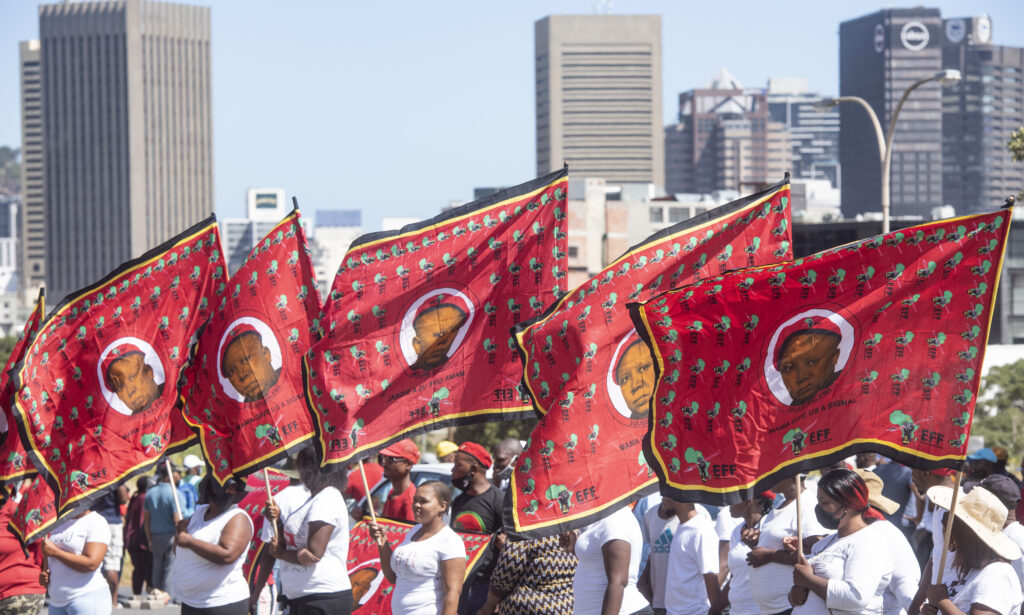
The EFF’s principles are unshakeable
Unlike the ANC, the core values of the freedom fighters do not change with each leader it elects